Few episodes in the Old Testament carry as much moral weight and lasting consequence as the story involving King David and Bathsheba, an account that shifts abruptly from David's military triumphs into a narrative of abuse of power, cover-up, and its far-reaching aftermath. It's a story the biblical text treats with unusual directness, refusing to soften David's culpability despite his status as Israel's most celebrated king.
The Biblical Account
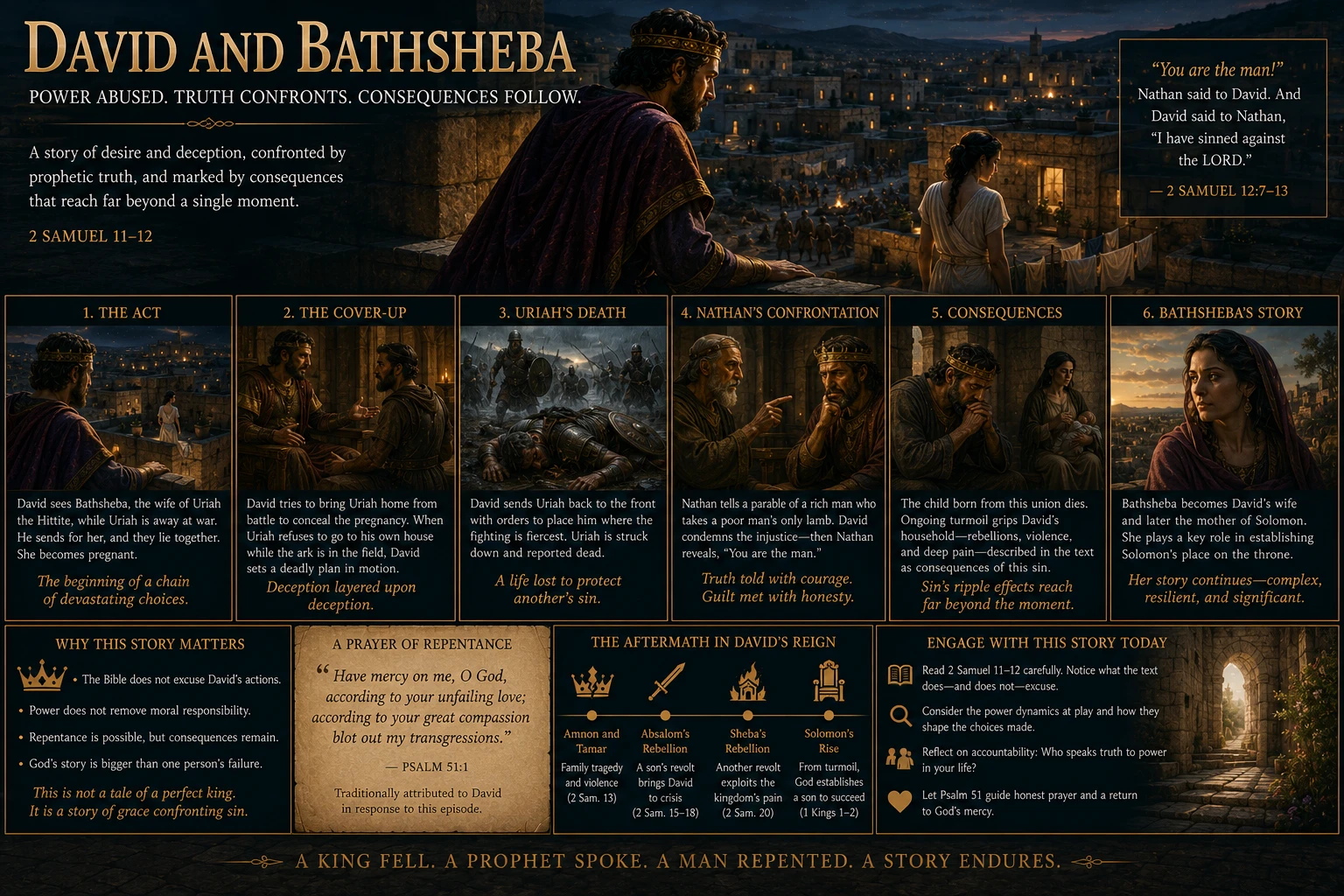
The narrative, recorded in 2 Samuel, begins with David observing Bathsheba, the wife of one of his soldiers, Uriah the Hittite, from the rooftop of his palace while Uriah was away at war. David summons her, and the text describes a sexual encounter that results in pregnancy, immediately creating a crisis given Uriah's absence and the social consequences such a pregnancy would expose.
Rather than acknowledging the situation, David attempts to arrange for Uriah's return from battle to obscure the child's true parentage, and when that plan fails, he ultimately arranges for Uriah to be placed in a deliberately vulnerable position during battle, resulting in his death.
A Story the Text Refuses to Soften
What distinguishes this account from many other ancient royal narratives is the biblical text's unwillingness to excuse or minimize David's actions, explicitly describing his behavior as a serious moral failure rather than framing it as an understandable exercise of royal privilege. The narrative's directness reflects a broader biblical pattern of holding even its most significant figures accountable within the text itself, rather than presenting them as beyond critique.
Nathan's Confrontation
The prophet Nathan confronts David directly, using a parable about a rich man who unjustly takes a poor man's only lamb, a story designed to lead David into recognizing and condemning his own actions before Nathan reveals the parable's true target. David's response, an immediate and unqualified acknowledgment of guilt, stands in notable contrast to the earlier concealment and manipulation the narrative describes.
This confrontation scene functions as one of the clearest examples in the Old Testament of prophetic accountability applied directly to a reigning monarch, establishing a precedent referenced throughout the rest of the biblical narrative regarding the relationship between political power and moral responsibility.
Consequences Described in the Text
The narrative describes significant consequences following this episode, including the death of the child born from the initial encounter and a period of ongoing turmoil within David's household that the text explicitly connects back to this event. Later chapters detail rebellion, family conflict, and political instability that the biblical narrative frames as consequences flowing directly from this earlier failure, rather than isolated, unrelated events.
Bathsheba's Role in the Narrative
Bathsheba herself receives comparatively limited direct characterization within this specific episode, though she reappears later in the biblical narrative as the mother of Solomon and an active participant in securing his succession to the throne. This later prominence has led to considerable scholarly and theological discussion regarding how her role in the initial episode should be understood, particularly given the significant power differential between a reigning king and one of his soldiers' wives.
Theological and Ethical Significance
This episode has generated extensive theological reflection regarding themes of power, accountability, repentance, and consequence, frequently cited as an example of how the biblical narrative refuses to present its central figures as morally uncomplicated. Psalm 51, traditionally attributed to David and understood as written in response to this episode, offers one of the Old Testament's most detailed literary expressions of repentance and reflects how seriously this failure was treated within the broader tradition.
Engaging With This Story Today
Readers interested in this account can find it recorded in 2 Samuel 11 and 12, with the aftermath extending through much of the remaining narrative describing David's reign. Approaching the story with attention to its power dynamics and its unflinching treatment of David's culpability offers a fuller, more honest engagement with one of the Old Testament's most morally significant episodes.