We hadn't planned to visit Jordan and Egypt back to back, but once the itinerary came together, it made perfect sense - two neighboring lands, separated by a narrow stretch of the Red Sea, each holding onto civilizations thousands of years old in strikingly different ways. Standing in Petra one week and at the base of the Great Pyramid the next gave us a rare chance to photograph two ancient worlds almost side by side.
Jordan: Carved Into Stone
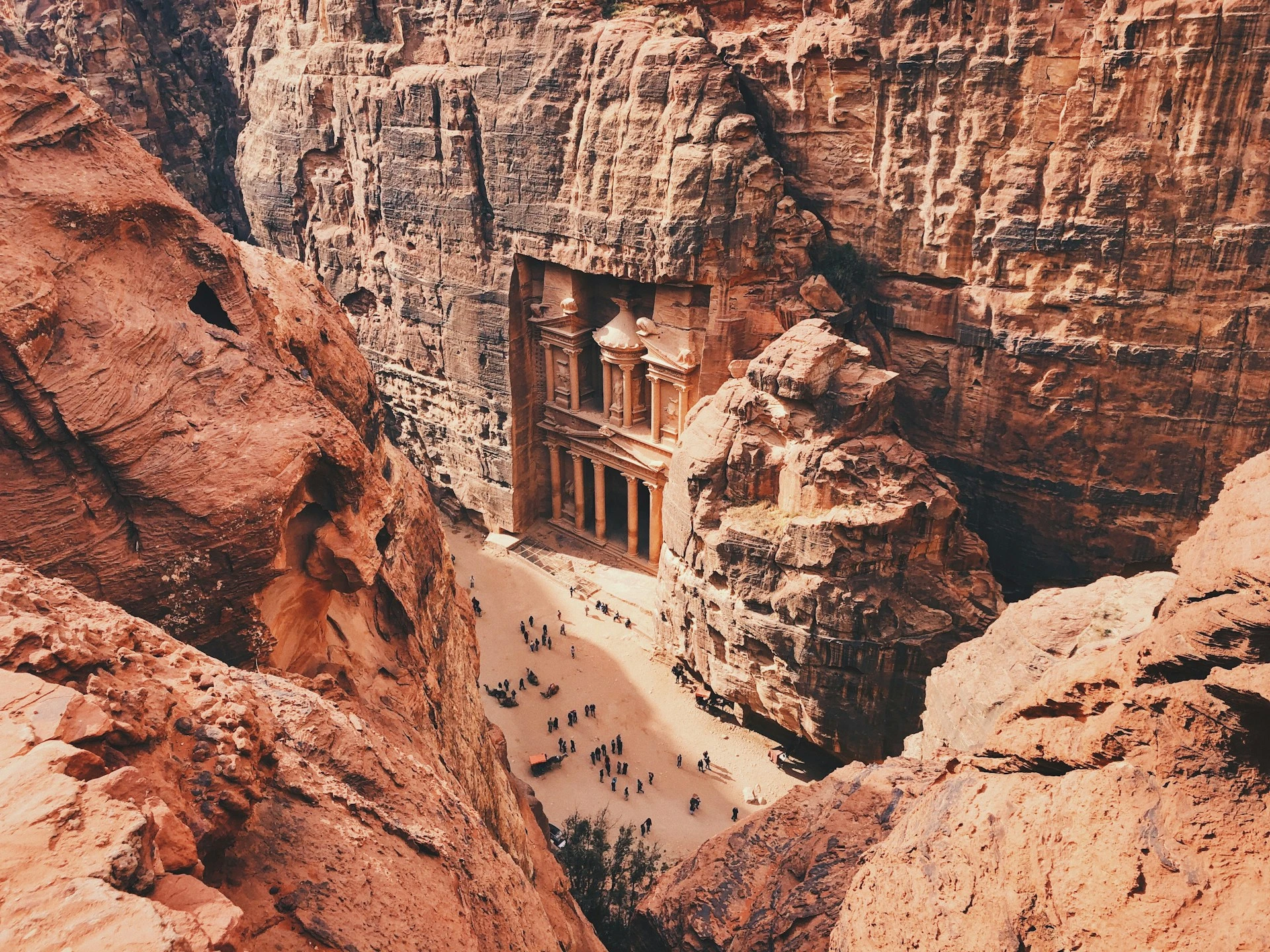
Petra is the kind of place that photographs almost force you to take. Walking through the narrow Siq canyon, with its walls rising higher and closer on either side, the first glimpse of the Treasury framed between rock faces is a moment we'd read about dozens of times and still weren't prepared for. We arrived early, before the tour groups, and had nearly twenty minutes with the Treasury almost entirely to ourselves.
Beyond the Treasury, Petra sprawls much further than most first-time visitors expect - the Monastery, reached by an 800-step climb, rewards the effort with far fewer crowds and a view across the entire valley. We spent a full day there and still felt like we'd only scratched the surface of what the ancient Nabataeans carved into these cliffs.
The Wadi Rum Desert
A short drive from Petra, Wadi Rum's red desert landscape felt like stepping onto another planet entirely - the same terrain used in several Mars-set films, and it's easy to see why once you're standing among its towering sandstone formations. We spent a night in a Bedouin camp under a sky so clear it made our long-exposure night shots almost effortless.
Crossing Into Egypt
The shift from Jordan to Egypt is more than geographic - Petra's Nabataean ruins feel intimate and carved into a living landscape, while Egypt's monuments operate on a completely different scale of ambition. Landing in Cairo, the Pyramids of Giza appearing suddenly at the edge of a busy modern city, was a contrast we weren't quite ready for after the quiet desert stillness of Jordan.
Egypt: Monuments Built to Last Millennia
We spent our first full day at Giza, photographing the pyramids from angles that avoided the busier tourist paths near the entrance - a short walk toward the desert's edge gave us a much cleaner, uncluttered view of all three pyramids in a single frame. The Sphinx, smaller in person than most photos suggest, still carries an undeniable presence up close.
Further south, a Nile cruise between Luxor and Aswan let us photograph temples that rarely make the highlight reels most travelers see beforehand - Karnak's forest of columns at sunrise, and the temple of Kom Ombo lit gold in the late afternoon. Abu Simbel, reached by an early morning convoy from Aswan, was worth the predawn wake-up call for the sheer scale of its facade alone.
Two Civilizations, One Frame
What struck us most, moving between the two countries, was how differently each civilization chose to leave its mark - Petra hidden and carved directly into rock, meant perhaps to be discovered rather than seen from a distance, while Egypt's monuments were built to dominate the skyline and be visible for miles. Photographing both within the same trip gave us a far richer sense of the ancient world's range than either destination could have offered alone.
Planning Your Own Trip
Spring and autumn offer the most comfortable temperatures for both countries, avoiding the harsher summer heat of the desert regions in each. Flights between Amman and Cairo are short and frequent, making a combined itinerary logistically easy, though we'd recommend at least five days in each country to avoid rushing either one.