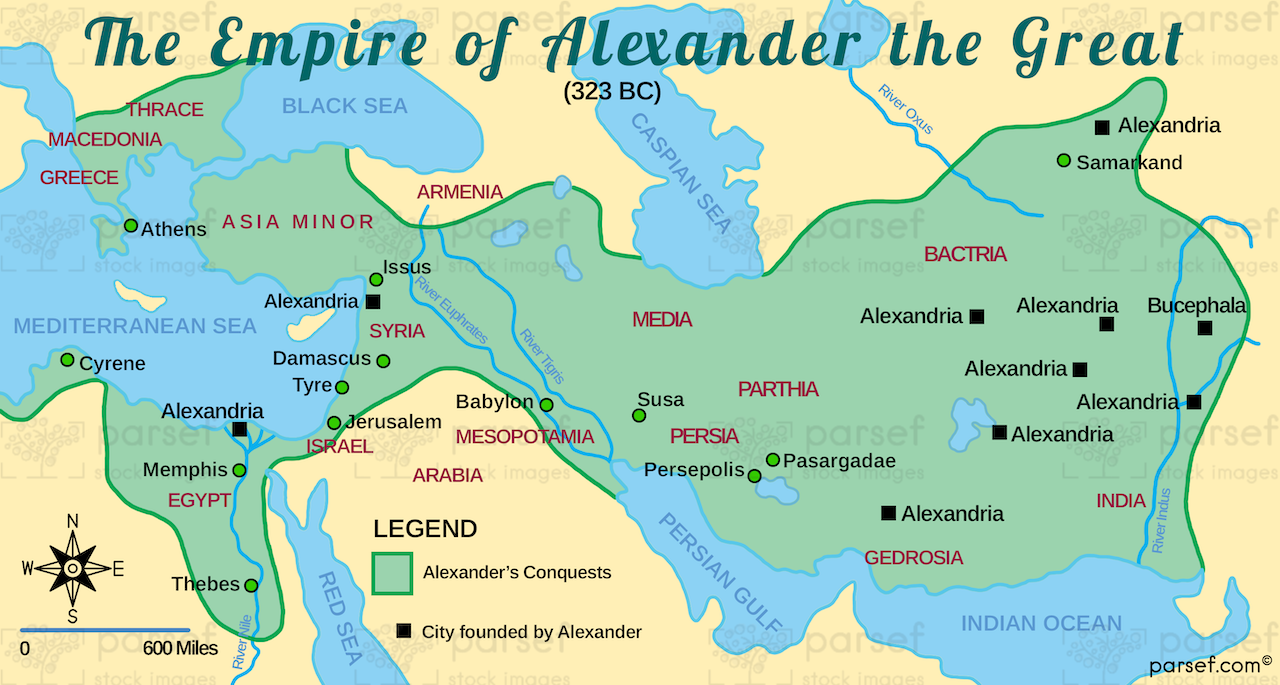
Alexander the Great built one of the largest empires the ancient world had ever seen, and this map traces just how far his conquests reached. Starting from Macedonia in 336 BC, he pushed east through Asia Minor, Egypt, and the heart of the Persian Empire, eventually reaching the Indus River in modern-day Pakistan before his army refused to go further. Along the way, he founded more than 20 cities bearing his name, the most famous being Alexandria in Egypt, which became a lasting center of learning and trade.
What makes this map especially useful for understanding biblical and ancient history is how it overlaps with regions mentioned throughout Scripture and later New Testament travels. Alexander's conquest reshaped the political and cultural landscape of the Near East, spreading Greek language and customs (a process known as Hellenization) that later influenced everything from trade routes to the spread of early Christianity. His empire didn't survive long after his death in 323 BC, splitting into several successor kingdoms, but its footprint on geography, language, and culture lasted for centuries.
Use this map to visualize the scale of his campaigns and see how they connect to other key regions in ancient history.