Few moments in the Old Testament carry as much dramatic weight as the parting of the sea, the climactic turning point of the Exodus story where Moses leads the Israelites to freedom through water that opens ahead of them and closes behind their pursuers. It's a scene that has shaped religious imagination for thousands of years, and standing near the region where tradition places this event, it's easy to understand why.
The Biblical Account
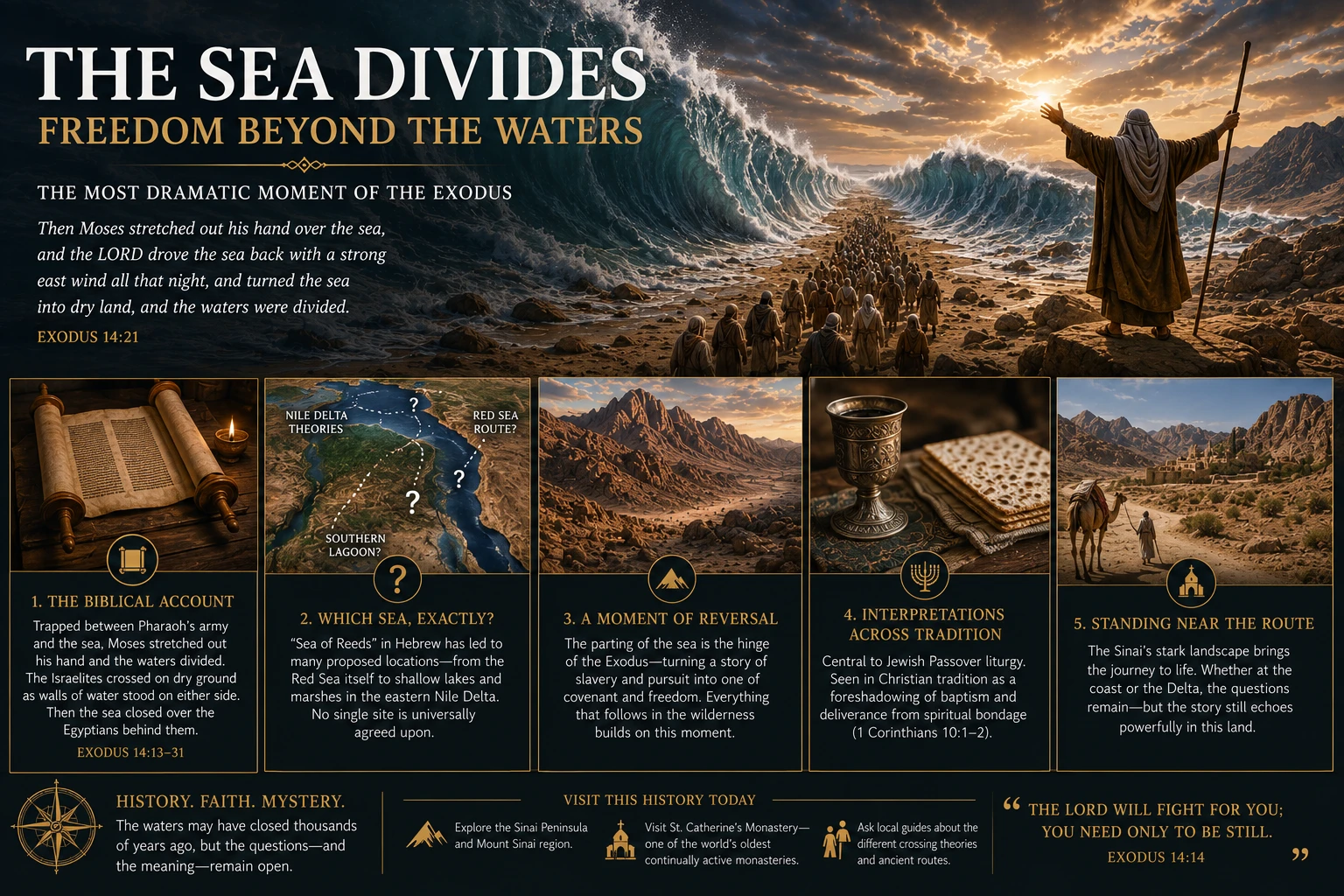
The Book of Exodus describes the Israelites trapped between the advancing Egyptian army and a body of water, with Moses stretching out his hand and the sea dividing to create a path of dry ground. The text describes walls of water on either side as the Israelites crossed, followed by the sea closing over the pursuing Egyptian chariots once the Israelites had reached the other side safely.
The narrative frames this not as a natural coincidence but as a decisive divine intervention, arriving at the exact moment the Israelites had nowhere left to run.
Which Sea, Exactly?
The Hebrew term traditionally translated as "Red Sea" is more accurately rendered as "Sea of Reeds," a detail that has fueled significant scholarly debate over the centuries about the precise body of water involved. Proposed locations range from sections of the modern Red Sea itself to shallower lakes and marshland historically present in the eastern Nile Delta region, with no single site universally agreed upon by historians or archaeologists.
We've walked stretches of the eastern Delta and the Sinai coastline that fall within various proposed crossing theories, and even experienced local guides will tell you plainly that the exact location remains an open question rather than a settled fact.
A Moment of Reversal
Structurally, the parting of the sea functions as the hinge point of the entire Exodus narrative, marking the transition from a story of bondage and pursuit to one of covenant and journey toward the Promised Land. Everything that follows in the wilderness narrative, from the giving of the law at Sinai to the decades of wandering, builds on this moment as its foundational turning point.
Interpretations Across Tradition
Jewish tradition treats the event as one of the central miracles recounted annually during Passover, embedded deeply into liturgy and ritual retelling. Christian tradition has frequently read the crossing typologically, drawing parallels to baptism and deliverance from spiritual bondage, a connection made explicitly in some New Testament writings.
Standing Near the Traditional Route
Traveling through the Sinai Peninsula, following portions of the traditional Exodus route toward Mount Sinai, gives a tangible sense of the landscape this story unfolds across, even without certainty about the exact crossing point. The stark, dry terrain surrounding much of the proposed route helps explain why a moment of dramatic water crossing would have loomed so large in the Israelites' collective memory.
Visiting This History Today
The Sinai Peninsula remains accessible to travelers interested in this narrative, with St. Catherine's Monastery near Mount Sinai serving as the most established anchor point for exploring the broader Exodus route. Local guides familiar with the region's competing crossing theories can offer useful context, though visitors should expect informed speculation rather than a single definitive site.