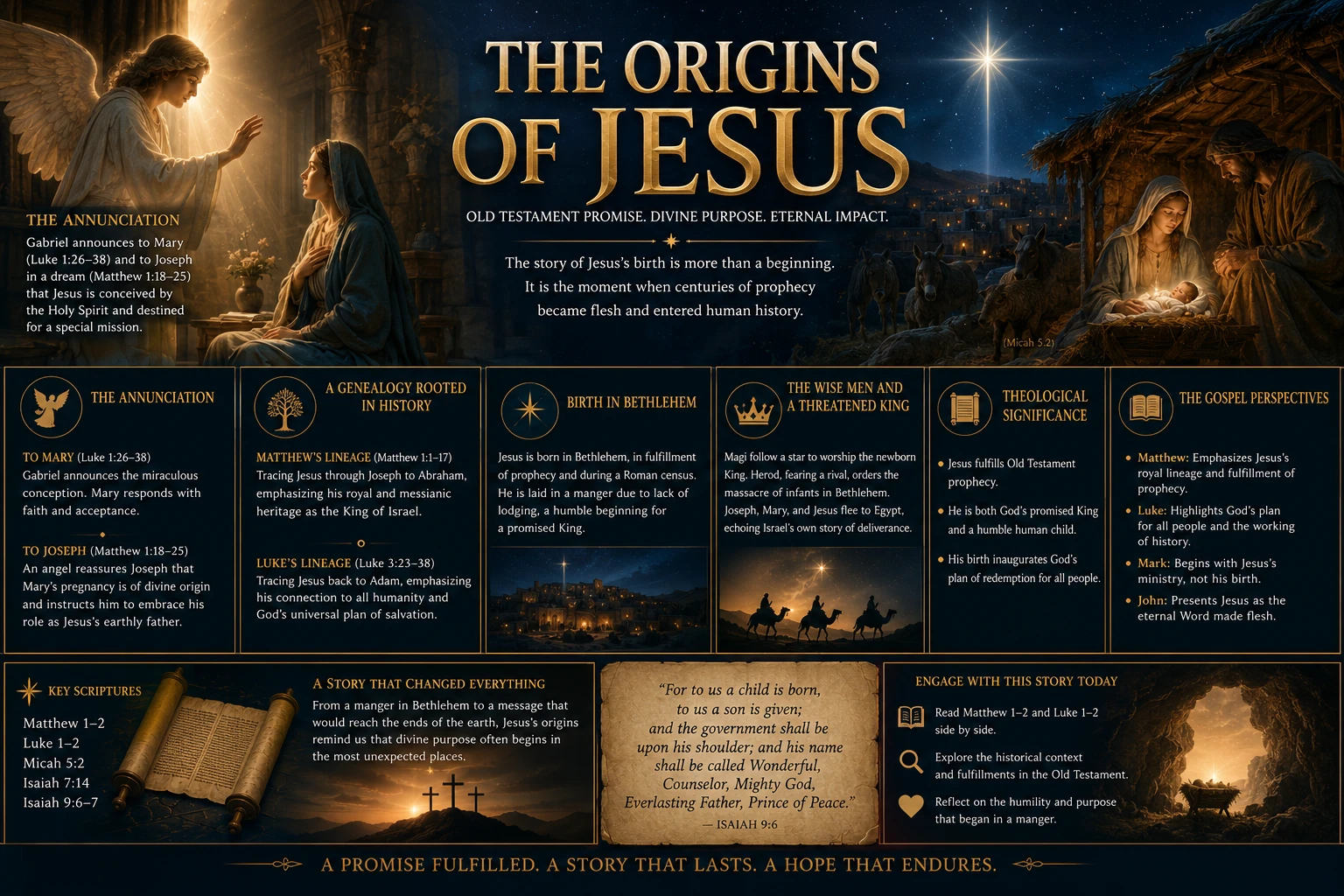
The story of Jesus's origins carries weight far beyond a simple birth narrative, functioning within the New Testament as the pivotal moment where centuries of Old Testament expectation and prophecy converge into a single, specific event. The Gospel accounts approach this origin story from distinct angles, each emphasizing different theological and historical dimensions of who Jesus was understood to be from the very beginning.
The Annunciation
The Gospel of Luke opens the narrative with the angel Gabriel appearing to Mary, a young woman in Nazareth, announcing that she would conceive and bear a son despite not yet being married, a message that carried both profound honor and significant social risk within her community. Mary's response, an acceptance of the announcement despite its disruptive implications for her life, has been read across centuries of Christian tradition as a model of faith and submission to divine purpose.
Matthew's Gospel approaches the same event from Joseph's perspective, describing his own initial distress upon learning of Mary's pregnancy and a subsequent angelic visitation reassuring him of the child's divine origin and instructing him to proceed with the marriage regardless of social expectation.
A Genealogy Rooted in History
Both Matthew and Luke include detailed genealogies tracing Jesus's lineage, though the two lists differ somewhat in structure and detail, a discrepancy that has generated substantial scholarly discussion over the centuries. Matthew traces the line through Joseph back to Abraham, emphasizing Jesus's connection to Jewish royal and patriarchal history, while Luke's genealogy extends further back to Adam, framing Jesus's origin within the context of all humanity rather than a single national lineage.
These genealogical differences reflect each Gospel's distinct theological priorities rather than necessarily indicating a factual contradiction, with Matthew emphasizing Jewish messianic expectation and Luke emphasizing a more universal scope.
Bethlehem and the Fulfillment of Prophecy
The Gospel accounts place Jesus's birth specifically in Bethlehem, a detail both Matthew and Luke connect directly to earlier Old Testament prophecy, particularly a passage in the Book of Micah identifying Bethlehem as the birthplace of a coming ruler from Israel's ancient lineage. Luke's account additionally describes a Roman census requiring Joseph and Mary's travel from Nazareth to Bethlehem, situating the birth within a specific, verifiable historical and political context.
The humble circumstances of the birth itself, described in Luke as taking place in a setting typically used for animals due to a lack of available lodging, stand in deliberate contrast to the announcement of the child's exalted identity delivered to nearby shepherds by an angelic host.
Wise Men and a Threatened King
Matthew's Gospel introduces a separate narrative thread involving magi, or wise men, who travel from the east following a star they interpreted as signaling the birth of a significant new king. Their arrival in Jerusalem triggers alarm from King Herod, whose subsequent attempt to eliminate this perceived rival, described in the account of the massacre of infants in Bethlehem, forces Joseph and Mary to flee with the child to Egypt.
This flight into Egypt, itself echoing earlier biblical patterns of Israelite movement into and out of that same country, positions Jesus's early life within a broader biblical narrative of exile, protection, and eventual return.
Theological Significance of the Origin Story
Beyond its narrative details, the birth account carries substantial theological weight within Christian tradition, framing Jesus's arrival as the fulfillment of long-anticipated messianic prophecy while simultaneously emphasizing his humble, vulnerable entry into human history. This combination of exalted identity and humble circumstance became a recurring theme throughout the rest of the Gospel narratives describing Jesus's life and ministry.
Different Gospels, Different Emphases
It's worth noting that Mark and John, the other two Gospels, take markedly different approaches to Jesus's origins, with Mark omitting a birth narrative entirely and John instead opening with a theological reflection on Jesus's preexistence, describing him as the eternal Word present from the very beginning. These differing approaches reflect each Gospel's distinct audience and theological focus, rather than a single unified account all four texts were attempting to replicate.
Engaging With This Story Today
Readers interested in comparing these accounts can find the birth narratives specifically in Matthew and Luke, with each offering complementary rather than fully overlapping details worth reading side by side. Approaching the differences between Matthew, Luke, Mark, and John's treatments of Jesus's origins with curiosity, rather than expecting strict uniformity, offers a richer understanding of how each Gospel writer chose to frame the same foundational event.