Solomon's Temple stands as one of the most consequential structures in biblical history, transforming Jerusalem from a political capital into the fixed spiritual center of Israelite religious life. Its construction, design, and eventual destruction shaped centuries of theology, ritual practice, and national identity that extended well beyond the building's physical existence.
Why the Temple Was Built
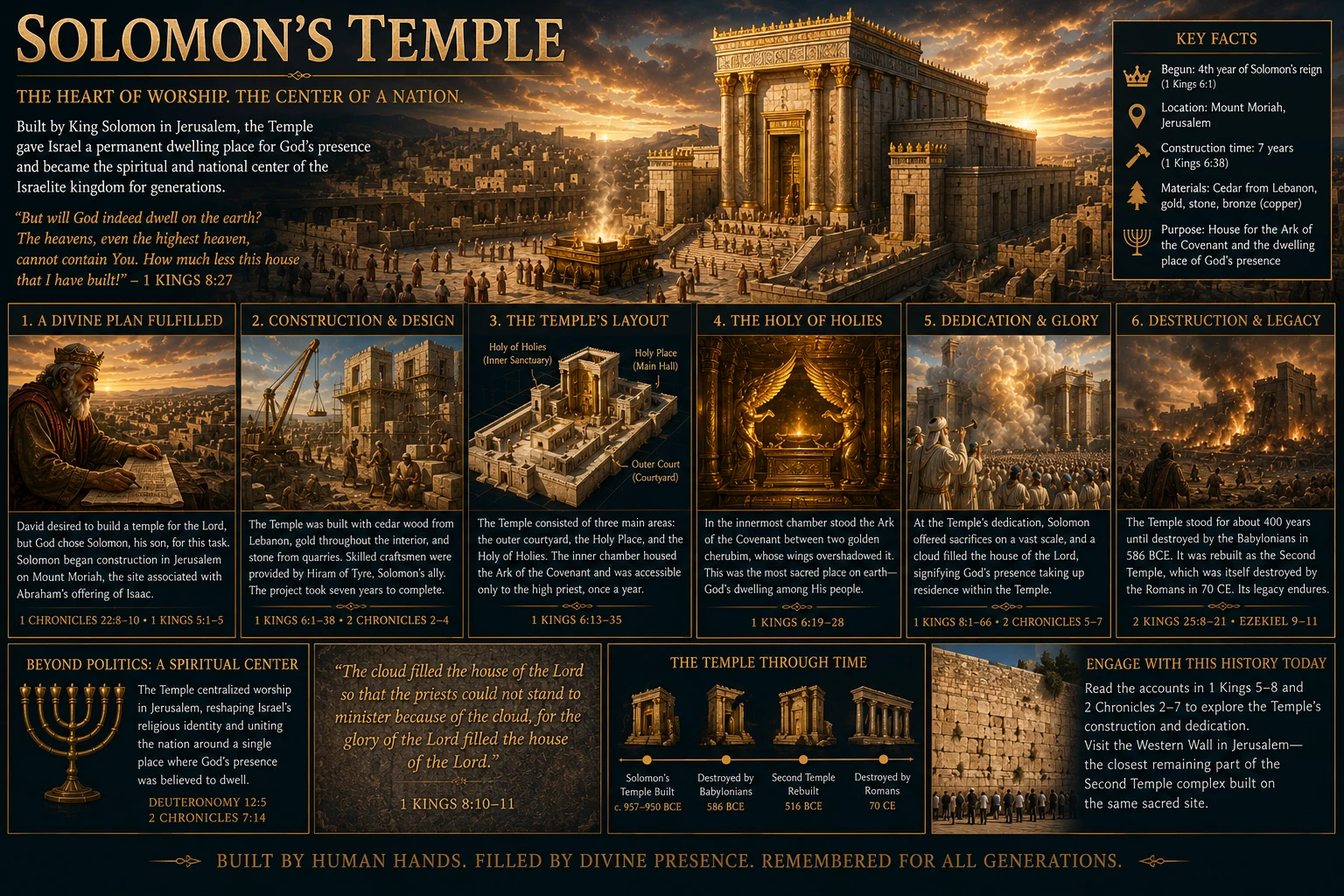
The idea for a permanent temple originated with King David, who wanted to build a fixed dwelling place for the Ark of the Covenant rather than the portable Tabernacle that had accompanied the Israelites since the wilderness period. According to the biblical account, David was told the task would fall to his son instead, and Solomon, upon taking the throne, began construction in the fourth year of his reign.
The Temple's location on Mount Moriah in Jerusalem carried significant symbolic weight, traditionally associated with the site of Abraham's binding of Isaac generations earlier, tying the new structure directly into Israel's earlier patriarchal history.
Construction and Design
The Book of Kings describes the Temple's construction in considerable detail, noting the use of cedar wood imported from Lebanon, extensive gold overlay throughout the interior, and skilled craftsmen brought in through an alliance with King Hiram of Tyre. The project reportedly took seven years to complete and required a massive labor force, reflecting the scale of ambition behind the undertaking.
The Temple's layout followed a tripartite structure: an outer courtyard, a main hall known as the Holy Place, and an innermost chamber called the Holy of Holies, which housed the Ark of the Covenant and could only be entered by the high priest, and only on specific ritual occasions.
The Holy of Holies
The innermost chamber represented the Temple's theological center, understood as the specific place where God's presence dwelt among the Israelites in a uniquely concentrated way. Two large golden cherubim stood within this chamber, their wings said to overshadow the Ark, reinforcing the space's function as the most sacred location in the entire Israelite religious system.
Access to this chamber was so restricted that even priests generally did not enter it, underscoring how the Temple's design physically embodied a hierarchy of sacredness moving from the outer courts inward.
The Temple's Dedication
Solomon's dedication of the Temple, recorded in detail in the Book of Kings, included an extensive public prayer and the offering of sacrifices on a scale the text describes as unprecedented, with thousands of animals offered during the ceremony. The narrative describes a cloud filling the Temple at the moment of dedication, understood within the text as a visible sign of divine presence taking up residence within the completed structure.
Political and Religious Significance
Beyond its religious function, the Temple served as a unifying symbol for the Israelite kingdom, centralizing worship practices that had previously been more dispersed and reinforcing Jerusalem's status as both political and spiritual capital. This centralization had lasting consequences for how Israelite religious identity developed, shifting emphasis toward a single, fixed sacred site rather than multiple regional locations.
Destruction and Legacy
Solomon's Temple stood for roughly four centuries before its destruction by the Babylonians in 586 BCE, an event that marked one of the most significant traumas in Israelite history and directly shaped much of the theological reflection found in the prophetic books written during and after the exile. Its destruction, and the later construction of a Second Temple following the return from Babylonian exile, established a pattern of loss and rebuilding that would recur again centuries later with the Second Temple's own destruction by Rome in 70 CE.
Why the Temple Still Matters
Solomon's Temple continues to hold profound significance well beyond its physical disappearance, remaining central to Jewish liturgy, theology, and historical memory, and referenced repeatedly throughout Christian scripture as well. Its absence, as much as its historical existence, has shaped religious thought and practice for over two thousand years.
Engaging With This History Today
Readers interested in the Temple's construction and dedication can find detailed accounts in 1 Kings and 2 Chronicles, offering complementary perspectives on the same events. The Western Wall in Jerusalem, a remaining retaining wall from the Second Temple complex built on the same site, remains the closest physical connection travelers can visit today, though it postdates Solomon's original structure by centuries.