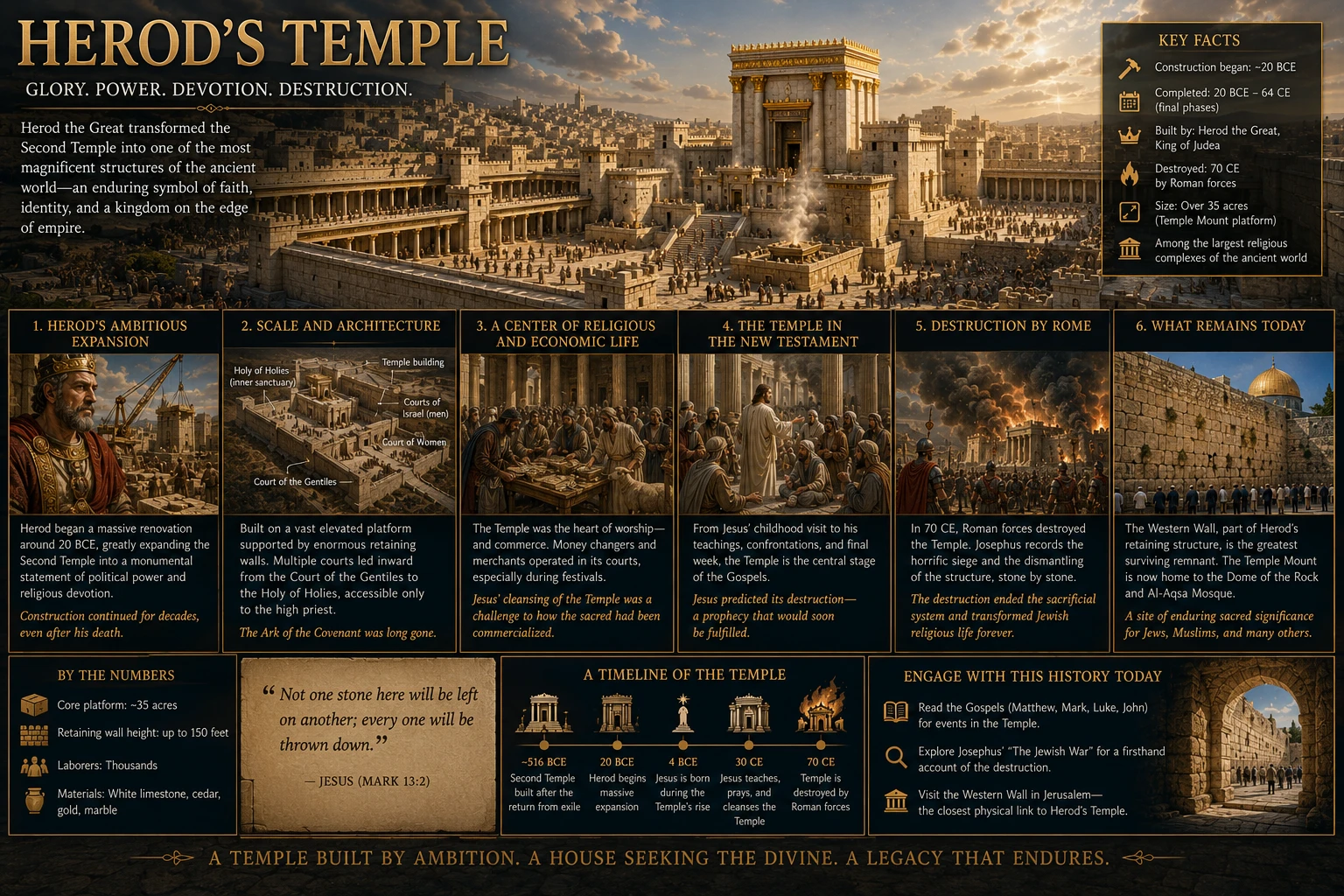
Herod's Temple represents one of the most ambitious building projects in the ancient Near East, transforming the modest Second Temple into a structure of staggering scale and grandeur. Its story spans political ambition, religious significance, and a destruction so total that it reshaped Jewish religious life for centuries afterward.
Herod's Ambitious Expansion
Herod the Great, the Roman-appointed King of Judea, began a massive renovation and expansion of the existing Second Temple around 20 BCE, transforming what had been a comparatively modest structure into one of the largest religious complexes in the ancient world. The project was as much a political statement as a religious one, reflecting Herod's broader pattern of large-scale construction projects intended to secure his legacy and demonstrate loyalty to Rome while also appealing to his Jewish subjects.
Construction continued well beyond Herod's own lifetime, with some elements of the broader complex still being completed just years before the entire structure was destroyed.
Scale and Architecture
The expanded Temple Mount platform Herod created was massive by ancient standards, supported by enormous retaining walls, portions of which still survive today, including the section known as the Western Wall. The complex included multiple courtyards arranged in a hierarchy of access, from the outer Court of the Gentiles, open to non-Jewish visitors, moving inward through progressively more restricted spaces reserved for Jewish worshippers, priests, and ultimately the high priest alone.
The Temple building itself, situated at the center of this vast complex, retained the traditional tripartite structure of earlier Israelite temples, including an inner Holy of Holies, though by this period the Ark of the Covenant itself was long absent, its fate unknown since the earlier Babylonian destruction centuries before.
A Center of Religious and Economic Life
Herod's Temple functioned as far more than a place of sacrifice and prayer; it served as the economic and social center of Jewish life in Jerusalem, housing money changers, merchants selling sacrificial animals, and vast crowds during major festivals like Passover. This commercial activity within the Temple courts forms the backdrop for the New Testament account of Jesus overturning tables in the Temple, a scene often interpreted as a direct challenge to how the sacred space had come to be used.
The Temple in the New Testament
Herod's Temple provides the setting for numerous key moments throughout the Gospels, including Jesus's presentation as an infant, his teaching sessions with religious scholars as a young boy, and repeated confrontations with religious authorities during his adult ministry. The Temple's grandeur and significance make its later destruction, which Jesus is recorded predicting in several Gospel passages, all the more theologically significant within the broader New Testament narrative.
Destruction by Rome
Herod's Temple stood for less than a century before its complete destruction by Roman forces in 70 CE, during the suppression of the First Jewish-Roman War, an event recorded in detail by the historian Josephus, who witnessed portions of the siege firsthand. The destruction was so thorough that, according to Josephus's account, Roman soldiers dismantled much of the structure stone by stone, largely fulfilling an earlier prophecy attributed to Jesus regarding the Temple's eventual fall.
This destruction marked a permanent turning point in Jewish religious practice, ending the sacrificial system that had depended entirely on the Temple's existence and accelerating the shift toward synagogue-centered worship and rabbinic Judaism that continues to this day.
What Remains Today
The most significant surviving remnant of Herod's Temple complex is the Western Wall, part of the retaining structure supporting the original Temple Mount platform, which remains one of the most sacred sites in Judaism and a major destination for prayer and pilgrimage. The Temple Mount itself now houses the Dome of the Rock and Al-Aqsa Mosque, significant Islamic religious sites constructed centuries after the Temple's destruction, making the location one of the most historically layered and religiously significant sites in the world today.
Engaging With This History Today
Readers interested in Herod's Temple can find detailed historical accounts in the writings of Josephus, alongside numerous New Testament references throughout the Gospels describing events that took place within its courts. Visiting the Western Wall in Jerusalem today offers the closest direct physical connection to this history, standing at the base of retaining walls that have remained largely unchanged since Herod's original construction nearly two thousand years ago.