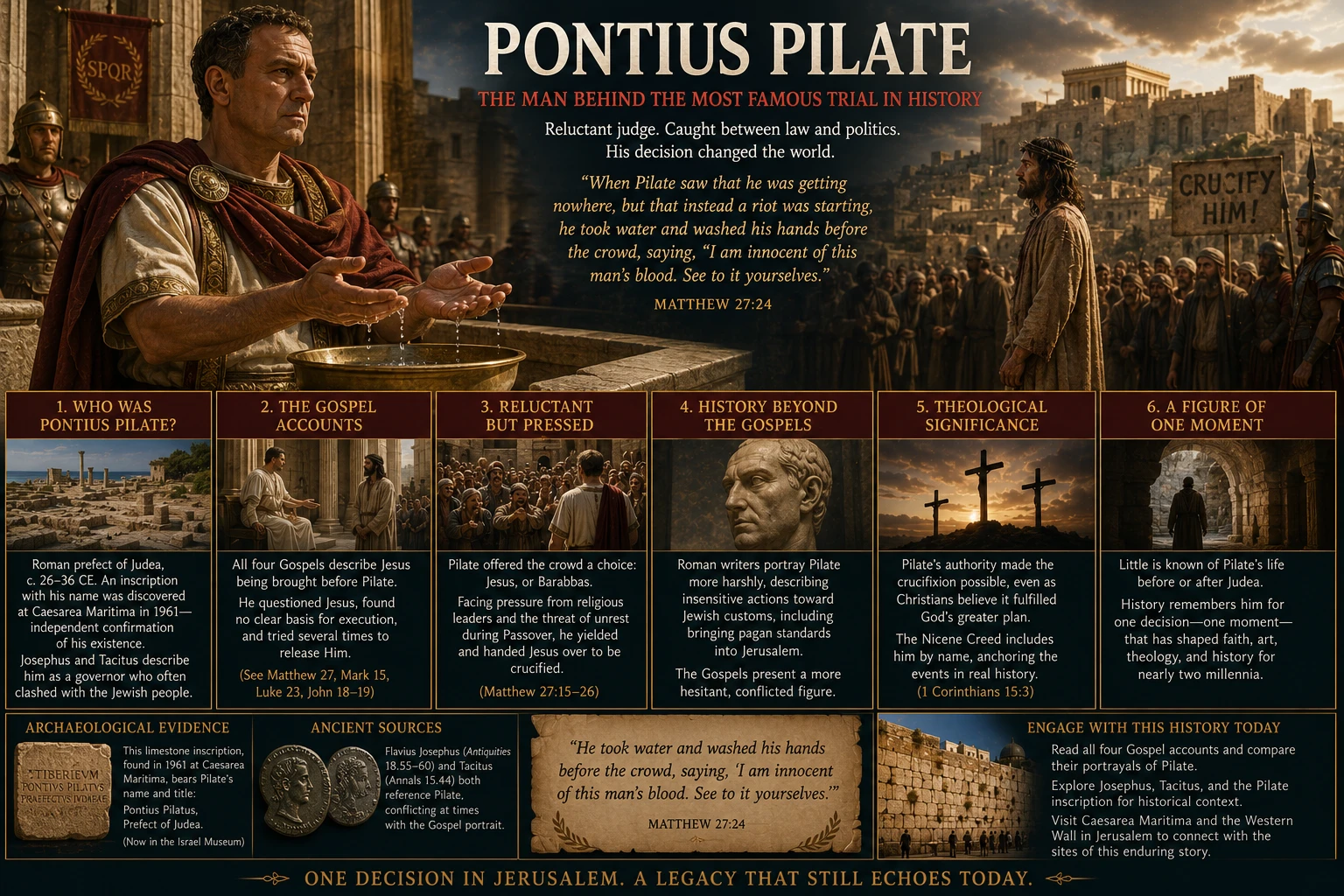
Pontius Pilate occupies a strange and uncomfortable position in the Gospel narratives, a Roman official thrust into the center of Christianity's defining event despite showing, by the text's own account, real reluctance to be there at all. His role in Jesus's trial and execution has been debated, reinterpreted, and scrutinized for nearly two thousand years, and the historical record adds important context the Gospels alone don't fully provide.
Who Was Pontius Pilate?
Pilate served as the Roman prefect of Judea from roughly 26 to 36 CE, a period confirmed independently through Roman historical sources and archaeological evidence, including an inscription bearing his name discovered at Caesarea Maritima in 1961. His position placed him in charge of Roman administrative and military authority over the region, including the final say over capital punishment cases brought before him, which is precisely the authority the Gospel narratives depend on for their account of Jesus's trial.
Roman historical sources outside the Bible, including references by the historian Josephus and the Roman writer Tacitus, describe Pilate as a governor known for friction with the Jewish population under his rule, occasionally handling local religious sensitivities with notable insensitivity.
The Gospel Accounts of the Trial
All four Gospels describe Jesus being brought before Pilate following his arrest, with Jewish religious authorities pressing for a death sentence on charges that carried more weight under Roman law, specifically claims tied to kingship and potential insurrection. The Gospel accounts depict Pilate questioning Jesus directly, finding no clear grounds for execution under Roman law, and attempting multiple times to avoid issuing the sentence himself.
The detail of Pilate washing his hands, recorded specifically in Matthew's Gospel, has become one of the most enduring images associated with him, symbolizing an attempt to distance himself from responsibility for a decision the text nonetheless shows him ultimately making.
Pilate's Reluctance and Political Pressure
The Gospel narratives consistently portray Pilate as caught between his own assessment of the case and mounting pressure from the crowd and religious leadership, eventually offering the crowd a choice between releasing Jesus or a prisoner named Barabbas. This detail reflects a broader political reality of Roman provincial governance, where local stability often took precedence over strict legal judgment, particularly during periods of heightened tension like Passover in Jerusalem.
Whether Pilate's reluctance reflects genuine moral hesitation or simple political calculation remains a point of ongoing interpretive debate, with the Gospels themselves offering some ambiguity on his underlying motivations.
Historical Pilate Versus Gospel Pilate
Roman sources outside the Bible paint a somewhat harsher picture of Pilate than the comparatively sympathetic, hesitant figure found in the Gospel accounts, describing incidents of heavy-handed treatment of Jewish religious sensitivities during his tenure. This contrast has led some historians to suggest the Gospel portrayal may soften Pilate's role somewhat, reflecting theological and narrative priorities as much as strict historical reporting.
Reconciling these differing portraits requires holding both sources in tension rather than assuming either account offers a complete, unbiased picture of the man.
Theological Weight of Pilate's Decision
Within Christian theology, Pilate's role carries significant weight as the figure whose official authority ultimately authorized the crucifixion, even as the broader narrative frames the event as unfolding according to a larger divine purpose beyond any single human decision. This tension between human agency and divine plan has generated centuries of theological reflection on questions of responsibility, free will, and providence within the crucifixion narrative.
The Nicene Creed's specific inclusion of Pilate by name, centuries after the events themselves, reflects how central his role became to establishing the historical anchoring of the crucifixion within early Christian doctrine.
A Figure Frozen in a Single Moment
Little is known about Pilate's life before or after his time in Judea, and historical sources suggest he was eventually recalled to Rome under circumstances that remain unclear. His entire historical legacy rests almost entirely on this one narrow window of decision-making, a detail that has made him a figure of ongoing fascination precisely because so much about him remains unresolved.
Engaging With This History Today
Readers interested in Pilate's role can find his account across all four Gospels, with each offering slightly different emphases and details worth comparing directly. Supplementing the Gospel accounts with independent historical sources like Josephus and the Caesarea inscription offers a fuller, more historically grounded picture of the man behind one of Christianity's most consequential decisions.