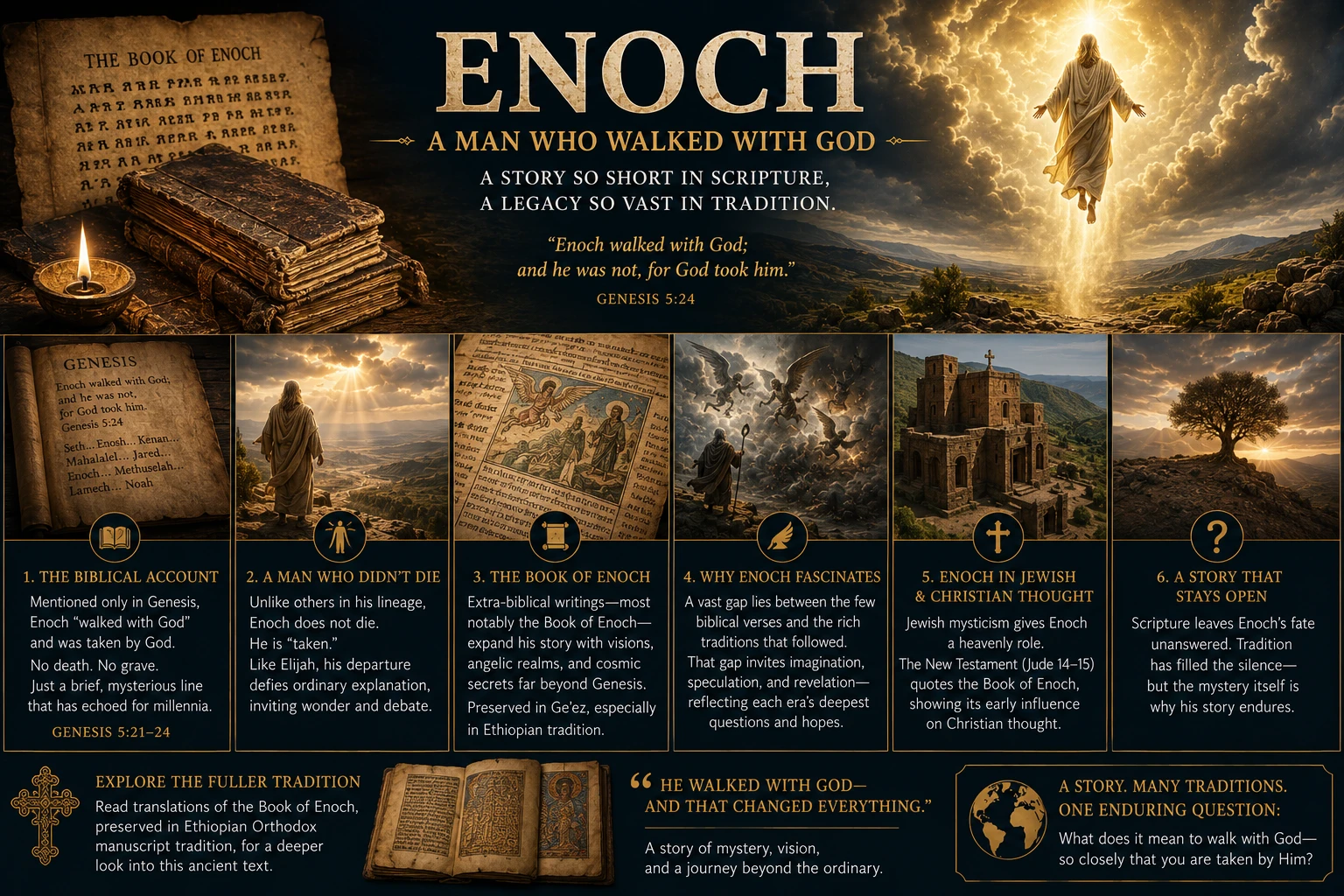
Few figures in the Old Testament receive as little direct text and as much later speculation as Enoch, a man mentioned only briefly in Genesis yet surrounded by centuries of extra-biblical tradition, mystery, and debate. His story is short, strange, and has generated far more curiosity than its length would suggest.
The Biblical Account
Genesis introduces Enoch within the genealogy stretching from Adam to Noah, describing him simply as a man who "walked with God" and, unlike every other figure listed in that lineage, does not die in the conventional sense. Instead, the text states that "God took him," a phrase that has puzzled and fascinated readers for thousands of years precisely because of how little it explains.
The entire biblical account of Enoch's life spans only a handful of verses, making him one of the shortest-documented figures in all of Genesis relative to the attention he has since received.
A Man Who Didn't Die
What sets Enoch apart from nearly every other early biblical figure is the ambiguous nature of his departure from the narrative, described not through death but through a kind of removal or translation directly by God. This detail places him in rare company within scripture, alongside figures like Elijah, whose own departure is similarly described as being taken up rather than dying in the ordinary sense.
That ambiguity has fueled centuries of theological and popular speculation about what exactly happened to Enoch, and why Genesis chose to describe his fate so differently from everyone else in the same genealogical passage.
The Book of Enoch
Enoch's brief appearance in Genesis inspired an entire body of extra-biblical literature, most notably the Book of Enoch, an ancient text not included in most biblical canons but preserved and considered authoritative within certain traditions, including the Ethiopian Orthodox Church. This text expands dramatically on Enoch's story, describing visionary journeys, fallen angels, and detailed cosmological narratives far beyond anything found in the brief Genesis account.
The Book of Enoch's survival owes much to Ethiopian religious tradition, which preserved the complete text in Ge'ez long after it had fallen out of use elsewhere, making Ethiopia a critical link in this text's continued existence.
Why Enoch Captivates Interpreters
Part of what makes Enoch such an enduring subject of fascination is the sheer gap between the minimal biblical text and the vast body of tradition that grew up around it, a gap that invites projection, speculation, and theological creativity in ways few other biblical figures allow. Readers across centuries have filled that gap with everything from apocalyptic visions to mystical numerology, often revealing as much about their own era's preoccupations as about Enoch himself.
Enoch in Jewish and Christian Thought
Jewish mystical tradition, particularly within later Kabbalistic writings, developed elaborate theories about Enoch's transformation and heavenly role after his removal from earth. Christian tradition references Enoch directly in the New Testament Book of Jude, which quotes material drawn from the Book of Enoch, indicating that at least some early Christian communities regarded the extended Enoch tradition as meaningful, even if not canonical scripture.
A Story That Stays Open
Enoch's narrative resists a tidy conclusion precisely because the biblical text offers so little to work with, leaving centuries of tradition, apocryphal literature, and theological debate to fill in a story that scripture itself leaves deliberately open. That openness is arguably the entire reason Enoch has remained such a persistently compelling figure across so many different religious traditions.
Engaging With This History Today
Readers interested in exploring Enoch's fuller tradition can seek out translations of the Book of Enoch, most completely preserved through Ethiopian Orthodox manuscript tradition, offering a far more detailed picture than the brief Genesis account alone provides. Approaching Enoch's story with curiosity about its ambiguity, rather than expecting definitive answers, tends to be the most rewarding way to engage with one of the Bible's most peculiar and enduring mysteries.