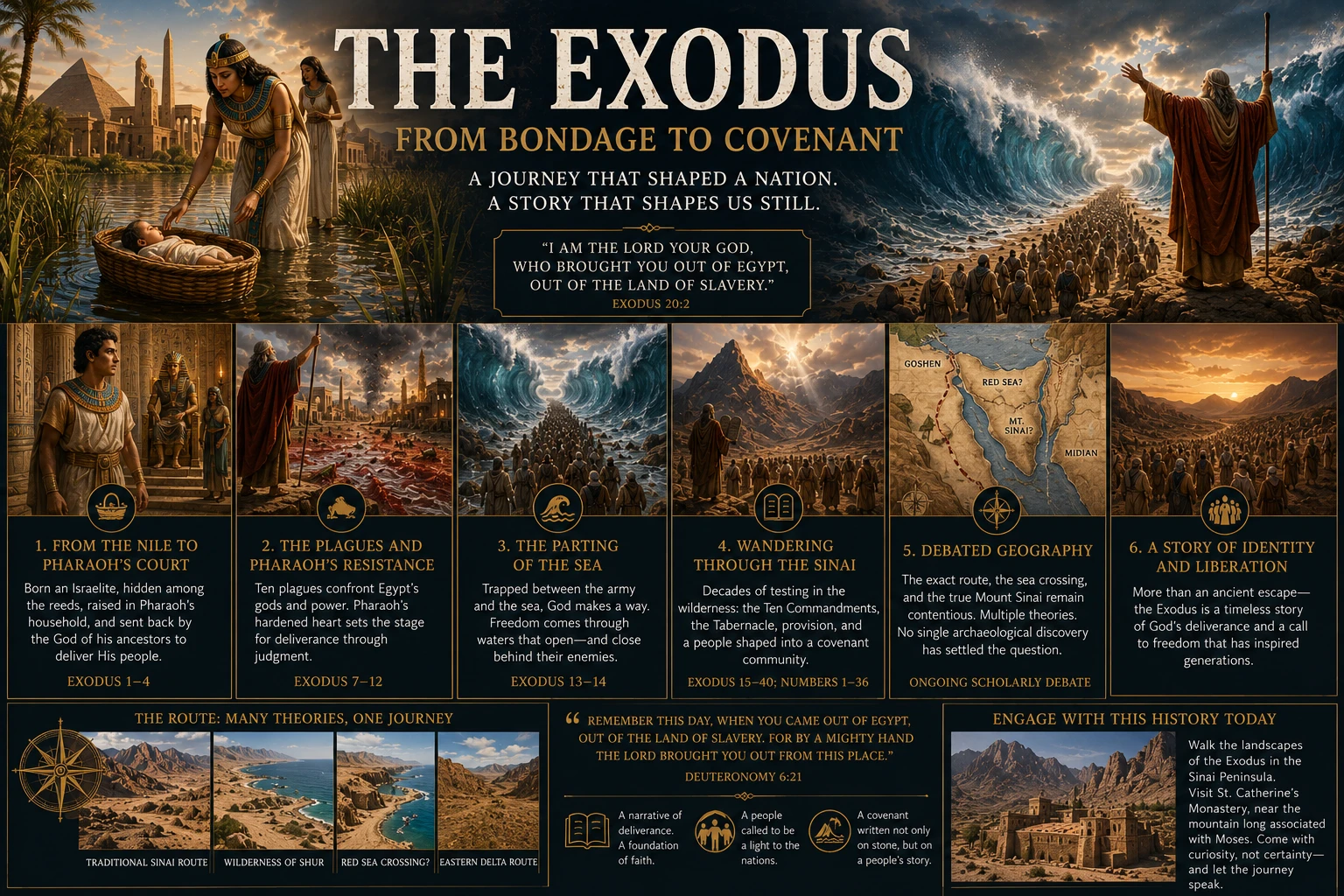
Few narratives in the Old Testament carry the scale and momentum of the Exodus, a story that moves from a single infant hidden in reeds along the Nile to an entire nation walking free through the wilderness toward a promised inheritance. It's a journey that unfolds across some of the most striking landscapes in the ancient Near East, and its structure has shaped religious storytelling for thousands of years.
From the Nile to Pharaoh's Court
Moses's story begins in Egypt, born to Israelite parents during a period of harsh oppression and hidden in a basket among the reeds of the Nile to escape a royal decree targeting Hebrew infants. Raised within Pharaoh's own household after being discovered by an Egyptian princess, Moses grows up straddling two identities before fleeing Egypt following an act of violence in defense of an enslaved Israelite.
Decades later, an encounter with a burning bush in the wilderness near Midian sends Moses back to Egypt with a divine commission: confront Pharaoh and demand freedom for the enslaved Israelites.
The Plagues and Pharaoh's Resistance
The confrontation between Moses and Pharaoh unfolds through a series of ten escalating plagues, from the Nile turning to blood to a final, devastating plague striking the firstborn of Egyptian households. Each plague functions narratively as both a demonstration of divine power and a direct challenge to Egyptian religious and political authority, since several plagues correspond symbolically to specific deities within the Egyptian pantheon.
Pharaoh's repeated refusal to release the Israelites, despite mounting devastation, builds the narrative tension that culminates in the Israelites' hurried departure following the final plague.
The Parting of the Sea
The most dramatic turning point in the entire narrative comes when the fleeing Israelites, trapped between the pursuing Egyptian army and a body of water, watch the sea part before them, allowing safe passage before closing over the pursuing chariots. This moment marks the definitive break between bondage and freedom, transforming the story from an escape narrative into the foundation of a covenant relationship.
Wandering Through the Sinai
Freedom didn't mean an immediate arrival at the Promised Land. The Israelites spent decades navigating the Sinai wilderness, receiving the Ten Commandments at Mount Sinai, building the Tabernacle, and facing repeated internal struggles with faith and obedience along the way. This extended wilderness period functions as a formative stage in the narrative, shaping the Israelites into a covenant community rather than simply a liberated population.
Debated Geography
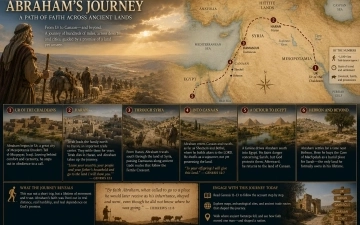
The exact route of the Exodus, including the precise location of the sea crossing and the true location of Mount Sinai, remains a subject of ongoing scholarly debate, with several competing theories proposed across different regions of the Sinai Peninsula and eastern Nile Delta. No single archaeological find has definitively settled the question, and most serious historical treatments of the Exodus acknowledge this geographic uncertainty rather than presenting a single confirmed route.
A Story of Identity and Liberation
Beyond its historical and geographic questions, the Exodus has functioned for millennia as a foundational narrative of liberation, invoked across countless later movements and traditions seeking freedom from oppression. Its structure, moving from bondage through trial to covenant, established a narrative pattern that continues to resonate well beyond its original religious context.
Engaging With This History Today
Travelers can walk portions of the traditional Exodus route through the Sinai Peninsula, anchored by St. Catherine's Monastery near the mountain long associated with Moses receiving the Ten Commandments. Approaching the journey with an awareness of its unresolved geographic questions tends to make the experience richer, treating the landscape as a space for reflection rather than a site offering definitive proof.