We've spent enough time tracing biblical geography across this continent to notice something that rarely gets emphasized in Sunday school retellings: the Bible doesn't just mention Africa in passing - it repeatedly returns to Egypt and Ethiopia as central settings for some of its most pivotal stories. Retracing that arc from north to south gave us a much fuller sense of how deeply African this history actually is.
Egypt: Where the Old Testament Begins in Earnest
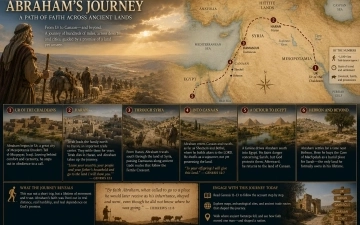
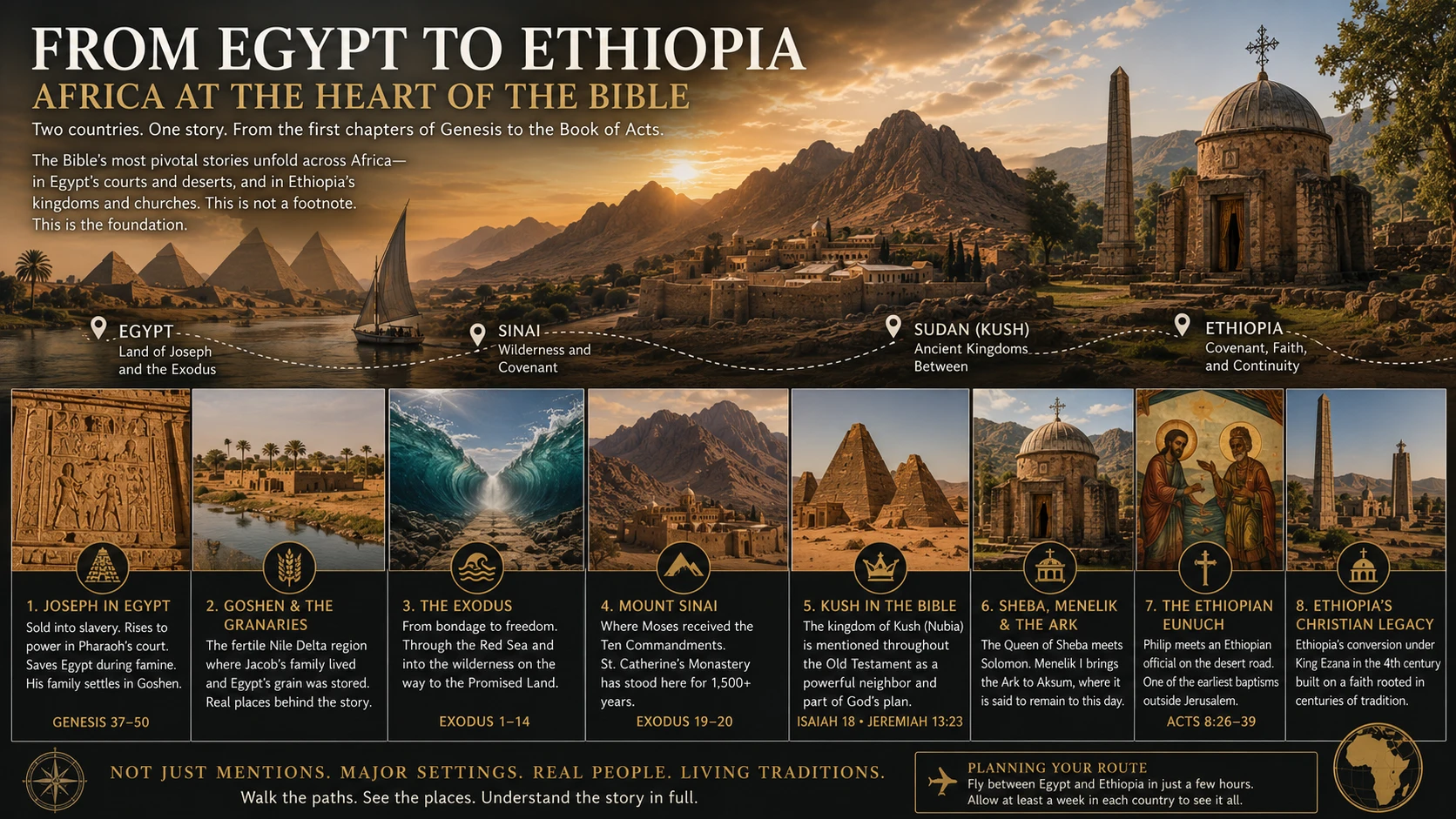
Egypt hosts some of the Old Testament's earliest extended narratives, starting with Joseph's rise from slavery to power within Pharaoh's court, and continuing through his family's eventual settlement in the Land of Goshen in the eastern Nile Delta. We've walked sites in this region historically tied to ancient Egyptian granary systems, the same infrastructure the biblical famine narrative describes Joseph managing on Pharaoh's behalf.
Generations later, that same land became the setting for the Exodus, with Moses leading the Israelites out of bondage, through the Red Sea, and into the Sinai wilderness on a journey toward the Promised Land. Mount Sinai, at the base of which St. Catherine's Monastery still stands as one of the world's oldest continuously active Christian monasteries, remains one of the most tangible physical links to this story that travelers can visit today.
The Sinai: A Bridge Between Two Testaments
The Sinai Peninsula sits at a strange geographic and narrative crossroads, technically part of Egypt but functioning in scripture almost as its own liminal space between bondage and covenant. Walking the desert routes here, we found it easy to understand why this landscape became so central to the biblical imagination of testing, wandering, and eventual arrival.
Ethiopia: A Different Kind of Biblical Setting
While Egypt dominates the Old Testament's earlier chapters, Ethiopia enters the biblical narrative through a different lens entirely - first through the Queen of Sheba's journey to meet King Solomon, and later through her son Menelik I, who Ethiopian tradition credits with bringing the Ark of the Covenant back to Aksum. That tradition remains deeply alive today, most visibly in the Chapel of the Tablet, guarded continuously by a single monk according to centuries-old practice.
Acts and the Ethiopian Eunuch
The New Testament revisits Ethiopia directly in the Book of Acts, describing an Ethiopian court official's encounter with the apostle Philip on a desert road, resulting in one of the earliest recorded baptisms outside Jerusalem. Ethiopian Christian tradition treats this moment as foundational, predating the country's formal conversion to Christianity under King Ezana in the fourth century by several hundred years.
Two Countries, One Continuous Thread
What struck us most, moving between Egyptian and Ethiopian sites tied to these stories, was how the biblical narrative treats Africa not as a single undifferentiated setting, but as several distinct regions each playing a specific narrative role - Egypt as the place of bondage and eventual departure, Ethiopia as a place of covenant, conversion, and continuity. Photographing both countries within the same broader project made that distinction far clearer than reading the texts in isolation ever had.
Sudan's Quiet Presence in Between
Between Egypt and Ethiopia geographically and narratively sits Sudan, home to the biblical Kush referenced throughout the Old Testament as a significant regional kingdom. We've found Sudan's Nubian sites, including the pyramids of Meroe, offer a quieter, far less crowded way to fill in this middle chapter of the same broader biblical geography.
Planning a Route Through This History
Egypt and Ethiopia connect easily via short regional flights, making a combined itinerary tracing this Old and New Testament thread logistically straightforward for most travelers. We'd recommend allowing at least a week in each country to properly take in both the well-known sites, like Sinai and Aksum, and the quieter locations that round out the fuller biblical picture.