Few figures in the Old Testament carry as much theological weight as Abraham, a man whose story shifts the biblical narrative from primeval history into the founding of a covenant people. His journey, spanning multiple countries, decades of waiting, and moments of profound testing, establishes faith and obedience as the defining themes of everything that follows in the Old Testament.
A Call to Leave Everything Behind
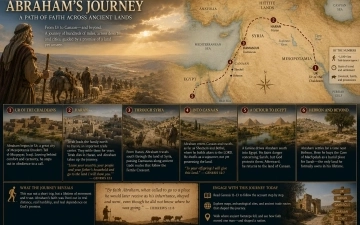
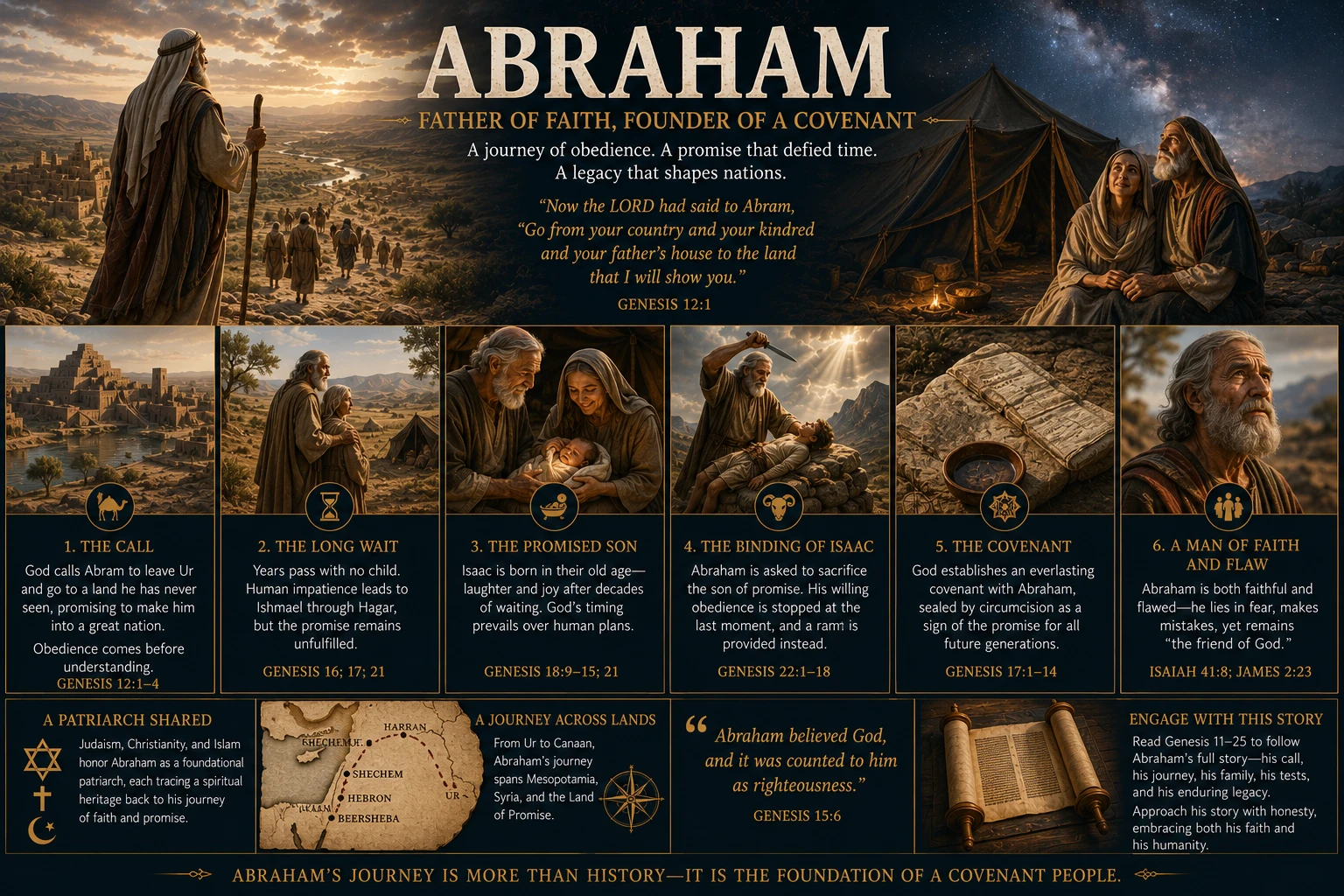
Abraham's story begins with a divine call to leave Ur, his ancestral home in Mesopotamia, and travel to a land he had never seen, promised to him and his descendants without any immediate proof or guarantee. This initial act of leaving behind family, homeland, and security establishes the pattern that will define his entire narrative arc: obedience preceding understanding, rather than following it.
The promise accompanying this call, that Abraham would become the father of a great nation, carried particular weight given his and Sarah's advanced age and lack of children at the time, a tension the narrative returns to repeatedly over the following chapters.
The Long Wait for a Promised Son
Much of Abraham's story unfolds across a lengthy period of waiting, doubt, and occasional attempts to force the promise's fulfillment through his own means, including the birth of Ishmael through Sarah's servant Hagar. This detour, born from understandable impatience rather than outright rebellion, introduces complications that ripple through the rest of the narrative and, in later tradition, through the broader story of the region itself.
The eventual birth of Isaac, decades after the original promise was given, functions narratively as proof that the covenant depended on divine timing rather than human intervention, a theme reinforced repeatedly throughout Abraham's story.
The Binding of Isaac
The most theologically intense moment in Abraham's narrative arrives when he is instructed to sacrifice Isaac, the very son through whom the covenant promise was meant to be fulfilled, on a mountain in the region of Moriah. The narrative offers no explanation softening the difficulty of this command, and Abraham's willingness to proceed, up until the moment he is stopped and provided a substitute offering, has generated centuries of theological reflection on the nature of faith, obedience, and divine testing.
This episode, often referred to as the Akedah in Jewish tradition, remains one of the most debated and discussed passages in the entire Hebrew Bible, read variously as a test of pure obedience, a foreshadowing of later sacrificial themes, or a profound meditation on trust under impossible circumstances.
Covenant and Circumcision
Abraham's relationship with God is formalized through covenant, marked physically by the practice of circumcision, establishing an enduring sign of the agreement between Abraham's descendants and the divine promise extended to them. This covenant becomes foundational not just to Abraham's immediate story, but to the entire theological framework the rest of the Old Testament builds upon.
A Man of Contradictions
Abraham's narrative doesn't present him as flawless; he lies about his relationship with Sarah out of fear on more than one occasion, and his handling of Hagar and Ishmael reflects deeply human failures alongside his moments of extraordinary faith. This complexity is part of what has made Abraham such an enduring figure across Jewish, Christian, and Islamic tradition, each of which claims him as a foundational patriarch while grappling with the same difficult, contradictory details.
A Shared Patriarch Across Traditions
Abraham's significance extends well beyond a single religious tradition, recognized as a founding patriarch within Judaism, Christianity, and Islam, each tracing distinct theological lineages back to his story. This shared reverence makes Abraham one of the few biblical figures whose narrative carries weight across multiple, sometimes competing, religious frameworks simultaneously.
Engaging With This Story Today
Readers interested in Abraham's full narrative can find his story spanning much of the Book of Genesis, from his initial call through the deaths of Sarah and eventually Abraham himself. Approaching the story with attention to both its moments of profound faith and its uncomfortable human failures offers a more complete picture than focusing on either extreme alone.