The Bible is filled with moments where the ordinary world abruptly gives way to something beyond it - burning bushes that speak, angels appearing without warning, and visions that upend the lives of those who receive them. These encounters aren't scattered randomly throughout scripture; they tend to follow recognizable patterns that reveal something about how the biblical text understands the relationship between the divine and the human.
Angelic Visitations
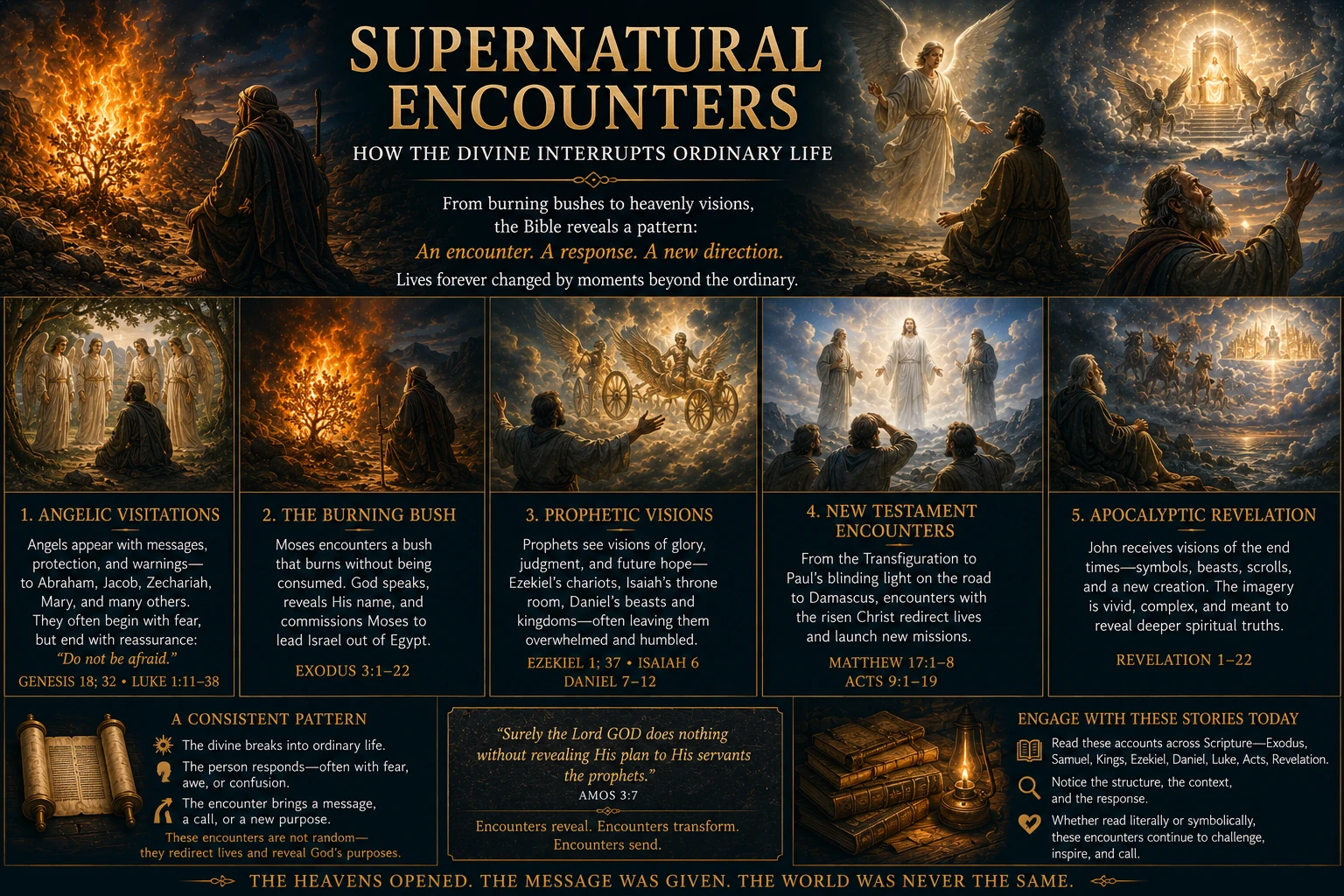
Angels appear repeatedly throughout both the Old and New Testaments, often arriving at pivotal moments to deliver messages, provide protection, or issue warnings. Abraham receives angelic visitors before the destruction of Sodom, Jacob wrestles with a mysterious figure by the Jabbok River, and the angel Gabriel appears to both Zechariah and Mary in the opening chapters of Luke, announcing the births of John the Baptist and Jesus respectively.
A recurring detail across many of these accounts is the initial fear or confusion of the person receiving the visitation, often met with a reassurance not to be afraid, suggesting the biblical text treats these encounters as genuinely overwhelming rather than routine.
The Burning Bush
Moses's encounter with a bush that burns without being consumed, recorded in Exodus, stands among the most iconic supernatural moments in the entire Old Testament. The scene combines a striking visual phenomenon with a direct verbal exchange, establishing both Moses's commission and the revelation of the divine name, a moment the text treats as foundational to Israel's entire subsequent religious identity.
Prophetic Visions
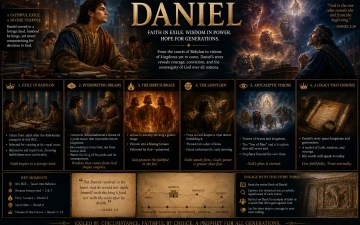
Several Old Testament prophets describe elaborate visionary experiences that go well beyond simple messages, including Ezekiel's vision of a valley of dry bones and his detailed description of divine chariots and living creatures, and Daniel's apocalyptic visions involving beasts and symbolic kingdoms. These visions often employ vivid, sometimes disorienting imagery, requiring interpretation either within the text itself or through centuries of subsequent theological reflection.
Isaiah's vision of the divine throne room, accompanied by seraphim and a dramatic sense of his own unworthiness, follows a similar pattern of overwhelming encounter followed by commissioning for a specific prophetic task.
New Testament Encounters
The New Testament continues this pattern with events like the Transfiguration, where Jesus appears radiant alongside Moses and Elijah before select disciples, and Paul's dramatic encounter on the road to Damascus, where a blinding light and voice fundamentally redirect the course of his life. Paul's experience in particular follows the established biblical pattern closely: an overwhelming encounter, an initial disorientation, and a resulting commission that reshapes the recipient's entire purpose.
The Book of Revelation extends this tradition further, presenting an extended apocalyptic vision delivered to John on the island of Patmos, filled with symbolic imagery that has generated centuries of interpretive debate.
Patterns Across These Accounts
Looking across these various encounters, a consistent structure emerges: an unexpected intrusion of the divine into ordinary life, an emotional response ranging from fear to awe, and typically a resulting change in the recipient's understanding or direction. This pattern suggests the biblical authors understood supernatural encounters not as isolated spectacle, but as functioning specifically to redirect and commission those who experienced them.
Interpreting These Accounts Today
Readers and scholars approach these passages from a range of perspectives, from treating them as literal historical events to reading them as theological literature communicating truth through vivid, symbolic narrative forms. Both approaches tend to agree that these accounts sit at the emotional and theological center of the biblical narrative, regardless of how one interprets their historical nature.
Engaging With This History Today
These accounts appear throughout the Old and New Testaments rather than concentrated in a single book, with Exodus, Ezekiel, Daniel, and Revelation offering some of the most extensive supernatural imagery in scripture. Approaching these passages with attention to their consistent narrative structure, rather than focusing solely on their dramatic imagery, offers a fuller sense of what these encounters were meant to communicate within their original context.