Few relationships in the Old Testament carry as much emotional and theological weight as the bond between Elijah and Elisha, a prophet and his chosen successor whose partnership models mentorship as a form of spiritual inheritance rather than simple apprenticeship. Their story spans dramatic confrontations, quiet moments of doubt, and one of the most unusual departures in all of scripture.
Elijah: A Prophet Forged in Crisis
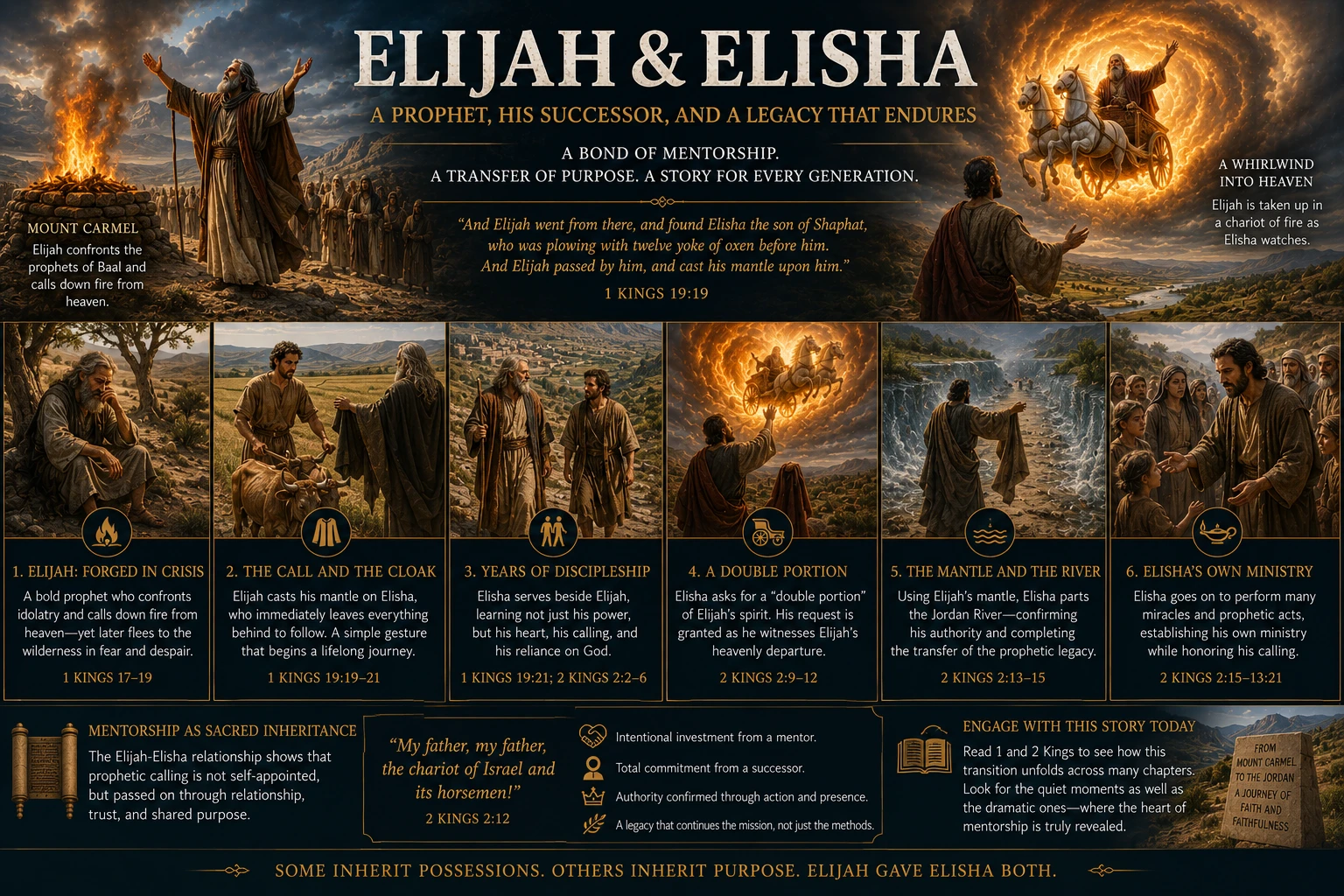
Elijah emerges in the Books of Kings as a fierce, uncompromising prophet during a period of widespread idolatry in Israel, most famously confronting King Ahab and the prophets of Baal in a public contest on Mount Carmel to prove the legitimacy of Israel's God. His ministry is marked by dramatic highs, including calling down fire from heaven, and equally dramatic lows, including a period of deep despair and flight into the wilderness following threats from Queen Jezebel.
It's in this wilderness moment, exhausted and questioning his purpose, that Elijah receives instructions to anoint Elisha as his eventual successor, a quieter and more personal turning point than his earlier public confrontations.
Elisha's Call and a Symbolic Cloak
Elisha's introduction into the narrative is understated compared to Elijah's fiery public ministry, marked by a simple gesture where Elijah casts his cloak over the younger man while he's working in a field. Elisha's response, leaving his oxen and immediate life behind to follow Elijah, establishes the pattern of total commitment that will define the rest of his own prophetic career.
The mentorship that follows spans years, with Elisha serving alongside Elijah and gradually absorbing both his prophetic authority and his particular way of engaging with kings, crises, and the wider community.
A Double Portion and a Fiery Departure
The culmination of their relationship arrives in one of the Old Testament's most visually dramatic scenes, where Elijah is taken up to heaven in a whirlwind, accompanied by a chariot and horses of fire, witnessed directly by Elisha. Before this departure, Elisha requests a "double portion" of Elijah's spirit, a request granted specifically because Elisha witnessed the departure itself, tying the transfer of prophetic authority directly to presence and continuity rather than formal ceremony alone.
Elisha's subsequent use of Elijah's fallen cloak to part the waters of the Jordan River, echoing an earlier miracle performed by his mentor, signals to the surrounding prophetic community that the succession is complete and legitimate.
Mentorship as Theological Structure
What makes the Elijah-Elisha relationship theologically significant is how explicitly the narrative frames succession and continuity as central to prophetic legitimacy, rather than treating each prophet as an isolated, self-authorized figure. This model of mentorship, transfer, and inherited authority echoes later throughout biblical tradition, including its influence on how later Jewish and Christian communities have understood spiritual succession and discipleship more broadly.
Elisha's Own Ministry
Following Elijah's departure, Elisha goes on to perform an extended series of miracles and prophetic acts across the remainder of Second Kings, from multiplying oil for a widow to raising a child from death, establishing his own distinct ministry while still operating within the framework his mentor established. His career demonstrates that effective succession isn't simply imitation, but a continuation shaped by the successor's own character and circumstances.
Why This Story Still Resonates
The Elijah-Elisha narrative continues to be cited across religious and even secular leadership contexts as an early model of intentional mentorship, precisely because it treats the transfer of purpose and authority as something requiring both deliberate investment from a mentor and genuine commitment from a successor. Their story suggests that meaningful continuity depends on relationship, not just formal designation.
Engaging With This Story Today
Readers interested in this narrative can find the full account across 1 and 2 Kings, where the transition between the two prophets unfolds gradually across multiple chapters rather than in a single dramatic scene. Approaching the story with attention to its quieter mentorship details, alongside its more famous miraculous moments, offers a fuller picture of why this relationship remains one of the Old Testament's most compelling examples of faith passed from one generation to the next.