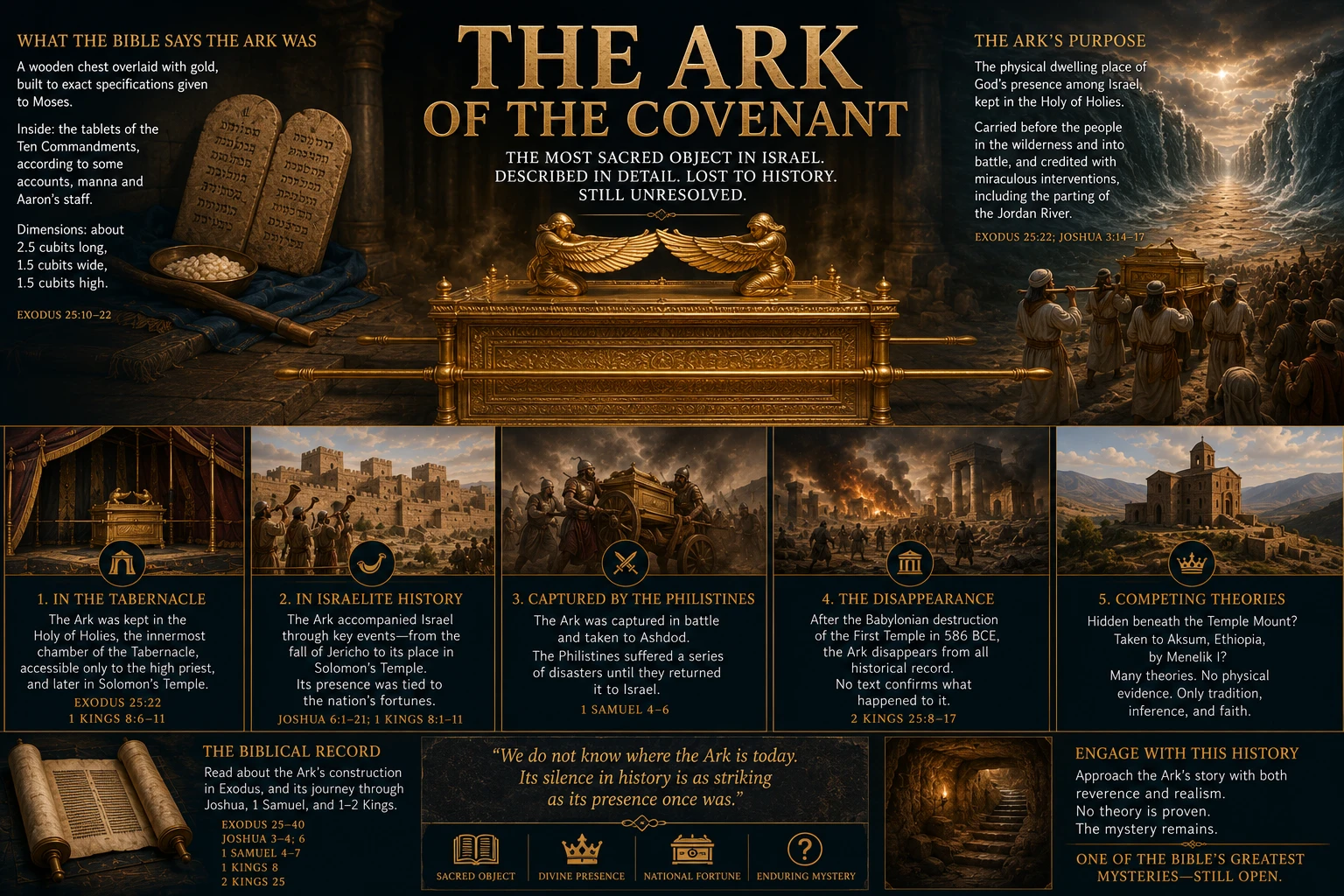
Few objects in biblical history carry as much enduring mystery as the Ark of the Covenant, a sacred chest described in exacting detail in the Old Testament yet lost from the historical record for well over two thousand years. Its story spans construction, sacred function, and an unresolved disappearance that continues to generate discussion to this day.
What the Bible Says the Ark Was
The Book of Exodus describes the Ark as a wooden chest overlaid with gold, built according to precise divine instructions given to Moses, measuring roughly the size of a small trunk and topped with two golden cherubim facing each other above the lid. Inside, the Ark was said to contain the tablets of the Ten Commandments, along with, according to some accounts, a portion of manna and Aaron's staff.
The Ark's construction wasn't treated as an ordinary craft project; the text emphasizes exact specifications and careful ritual handling, reflecting its status as the most sacred object in the entire Israelite religious system.
The Ark's Purpose
Beyond simply housing sacred objects, the Ark functioned as the physical focal point of God's presence among the Israelites, kept within the innermost chamber of the Tabernacle, and later the Temple in Jerusalem, accessible only to the high priest under strict ritual conditions. It also served a practical role during the wilderness period, carried ahead of the Israelites during military campaigns and credited in the biblical narrative with several dramatic interventions, including the parting of the Jordan River during the crossing into Canaan.
Its Role in Israelite History
The Ark accompanied the Israelites through key moments recorded in the Old Testament, from the fall of Jericho's walls to its eventual placement within Solomon's Temple following the completion of that structure. Its presence was treated as inseparable from the nation's fortunes, reflected in the text's account of the Ark's capture by the Philistines and the disastrous consequences that followed until it was returned.
The Ark's Disappearance
The Ark disappears from clear historical record after the Babylonian destruction of the First Temple in the sixth century BCE, with no biblical or extra-biblical text offering a definitive account of what happened to it during or after that destruction. This abrupt silence, following centuries of detailed narrative attention, has left the Ark's ultimate fate as one of the most significant open questions in biblical history.
Competing Theories
Several traditions have emerged over the centuries attempting to account for the Ark's fate, ranging from theories that it was hidden beneath the Temple Mount in Jerusalem before the Babylonian destruction, to Ethiopian tradition holding that it was brought to Aksum generations earlier by Menelik I, son of Solomon and the Queen of Sheba. No theory has produced verifiable physical evidence, and each remains rooted primarily in tradition, textual inference, or religious conviction rather than confirmed archaeological discovery.
Why the Mystery Persists
Part of what keeps the Ark's story so persistently compelling is the combination of extraordinarily specific biblical description with a complete absence of confirmed physical evidence following its disappearance. That gap between detailed textual record and total silence in the historical and archaeological record has left space for centuries of theological reflection, popular speculation, and competing cultural claims.
Engaging With This History Today
Readers interested in the Ark's biblical description can find its construction detailed in the Book of Exodus, with its subsequent history traced across Joshua, Samuel, and Kings. Approaching the Ark's disappearance with an awareness that no theory has been conclusively proven tends to offer a more accurate picture than treating any single tradition as settled historical fact.