We first came across the story of Ethiopia's Beta Israel community almost by accident, while researching Aksum's Christian history, and it opened up a much larger thread we hadn't fully appreciated before - Africa's connection to biblical history runs not just through geography and scripture, but through communities that carried that identity across the continent and beyond for centuries.
Beta Israel: Ethiopia's Ancient Jewish Community
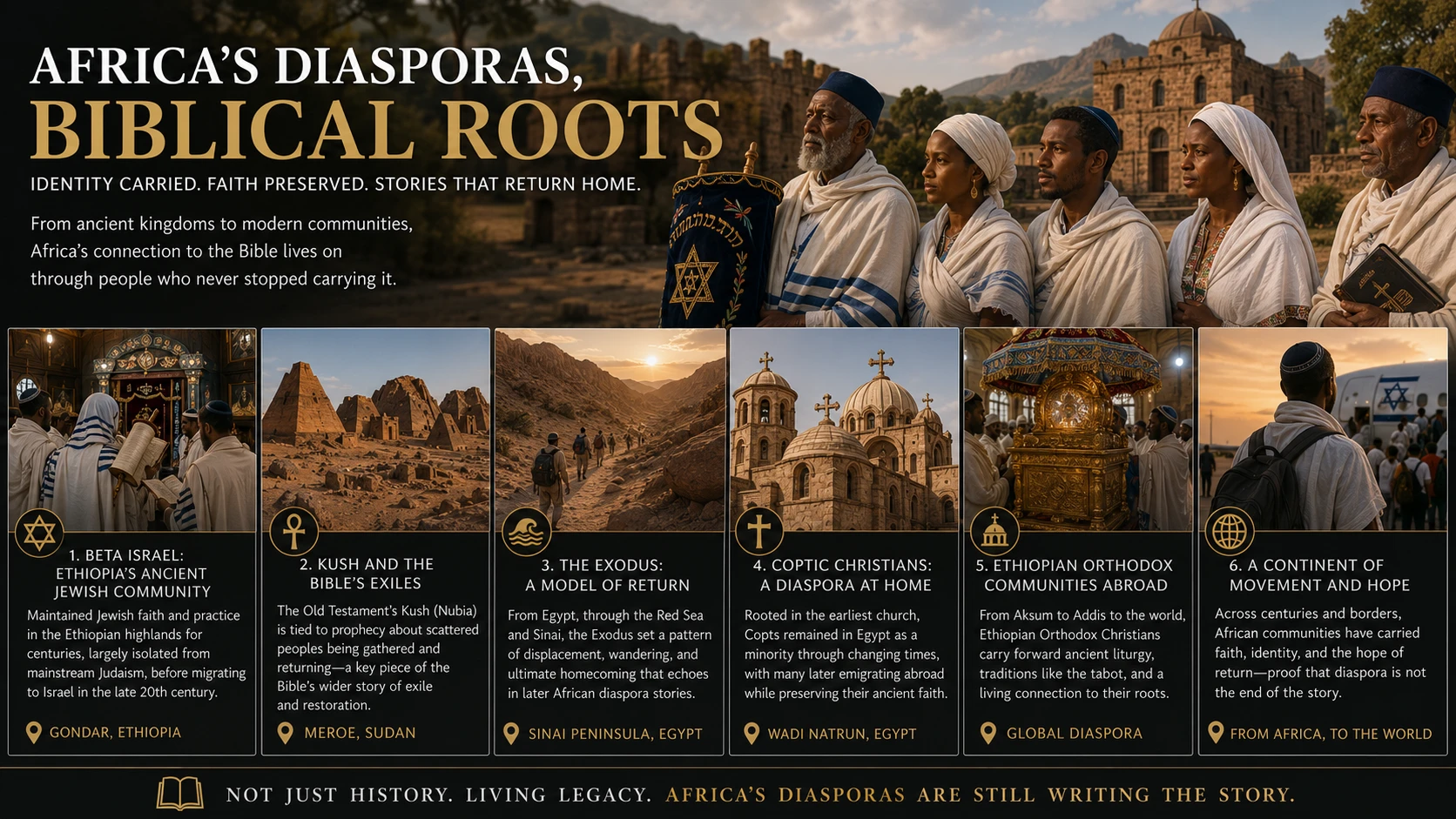
The Beta Israel, sometimes referred to historically as Ethiopian Jews, trace a Jewish identity and practice in the Ethiopian highlands that predates most written records of their origin, with some traditions linking them to the era of Solomon and Sheba, and others pointing to later migrations. Whatever their precise historical origin, the community maintained distinct religious practices, including Torah observance and Sabbath traditions, largely isolated from mainstream Judaism for centuries before large-scale migration to Israel in the late twentieth century.
Visiting the remaining Beta Israel communities and synagogues in the Gondar region gave us a strong sense of a diaspora story that unfolded almost entirely outside the narratives most people associate with Jewish history.
Kush and the Old Testament's African Exiles
The biblical Kush, corresponding to ancient Nubia in modern Sudan, appears repeatedly throughout the Old Testament not just as a foreign kingdom, but as a place tied to prophecy about scattered peoples eventually returning or being gathered. Several Old Testament prophetic books reference Kush specifically in the context of a wider ingathering of exiled and dispersed peoples, positioning the region as part of a much broader biblical geography of displacement and return.
The Exodus as a Foundational Diaspora Narrative
The Exodus itself, Africa's most famous biblical departure story, established a template of displacement, wandering, and eventual homecoming that would echo through later diaspora experiences across the region. Standing at sites along the traditional Exodus route through the Sinai, it's hard not to see that same pattern repeating centuries later in stories like Beta Israel's much longer, quieter migration home.
Coptic Christians: A Diaspora Within Their Own Land
Egypt's Coptic Christian community, tracing its roots to the earliest years of the church, represents a different kind of diaspora experience - a population that remained rooted in its ancestral land while gradually becoming a minority within it following the spread of Islam through the region. Significant Coptic emigration in recent decades, driven by periods of social and political pressure, has scattered communities into North America, Europe, and Australia, carrying Egypt's ancient Christian liturgy and identity into entirely new geographic contexts.
Ethiopian Orthodox Communities Abroad
Ethiopia's own Christian diaspora, particularly following political upheaval in the latter half of the twentieth century, has established Ethiopian Orthodox churches across major cities worldwide, each one carrying forward liturgical traditions, including the tabot practice tied directly to the Ark of the Covenant tradition in Aksum. Visiting an Ethiopian Orthodox service abroad, even far from Aksum itself, felt like encountering a direct continuation of the same religious lineage we'd photographed in the Ethiopian highlands.
A Continent Defined by Movement and Return
What ties these stories together, from Beta Israel's migration to Israel to the Coptic diaspora's spread across the world, is a recurring biblical pattern of communities carrying identity across distance rather than losing it. Africa's role in this sense isn't only as a place biblical stories happened, but as a source of ongoing diaspora narratives that continue unfolding well into the present.
Visiting These Communities Today
Travelers interested in this history can visit remaining Beta Israel heritage sites in Ethiopia's Gondar region, alongside active Coptic monasteries in Egypt's Wadi Natrun, though respectful visits require sensitivity given these are living religious communities, not historical exhibits. Understanding the diaspora side of this history adds a dimension to biblical travel in Africa that pure archaeology or ancient ruins alone can't fully capture.