We've come to realize, after years of traveling through Egypt, Ethiopia, and Sudan, that the road to the Promised Land didn't start in some distant, disconnected place - it started right here, on African soil. So much of the Old Testament's opening chapters unfold across this continent, long before the story ever reaches the borders of Canaan.
Joseph and the Rise of a Foreigner in Egypt
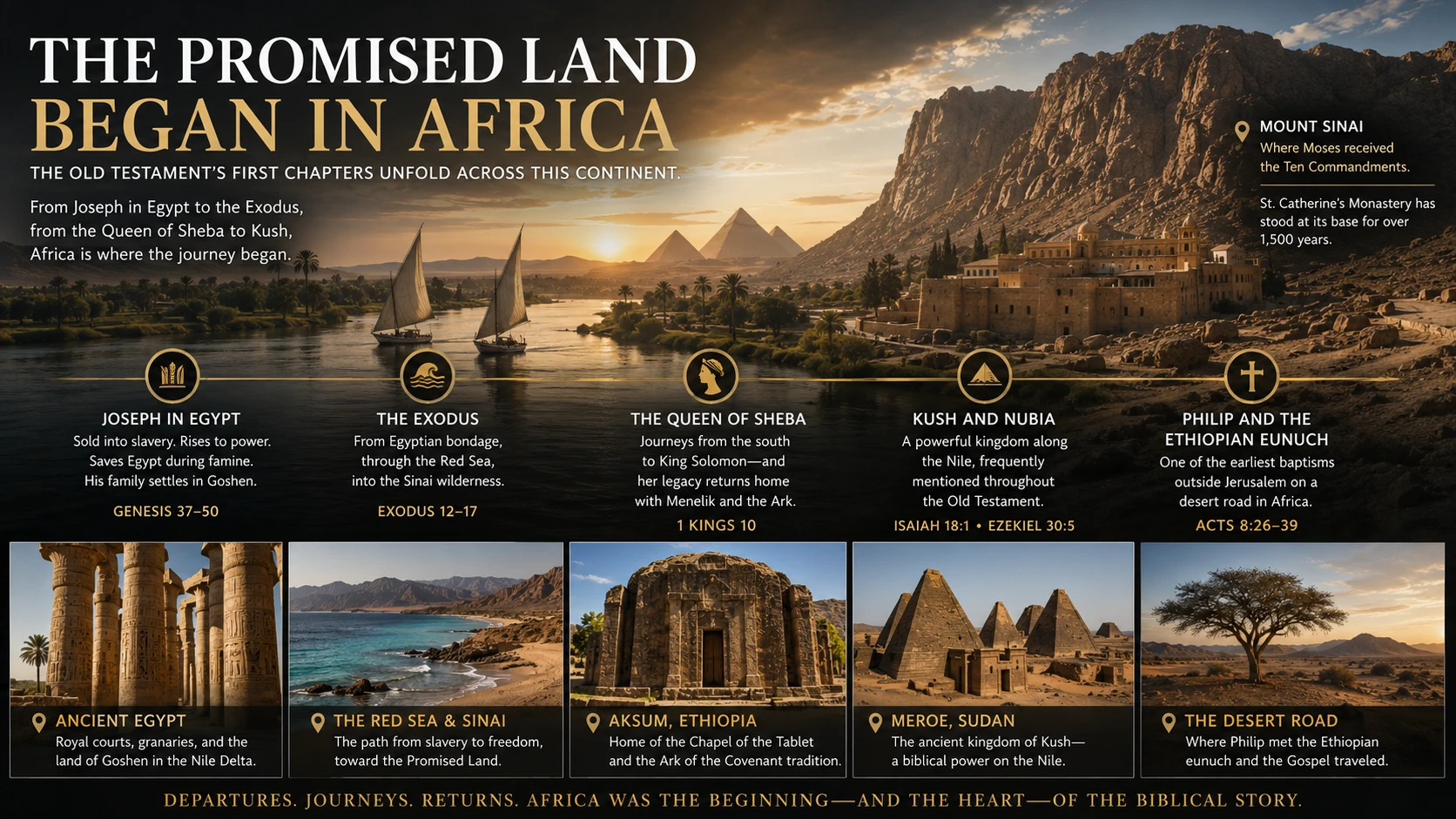
The story of Joseph, sold into slavery by his own brothers and rising to become one of Pharaoh's most trusted officials, is set almost entirely within Egypt's royal courts and granaries. Standing near sites historically associated with ancient Egyptian administrative centers, we found it easy to picture the famine-era grain stores the biblical account describes, systems the real historical Egypt was famous for managing with remarkable sophistication.
Joseph's family eventually settled in the Land of Goshen, in the eastern Nile Delta, a region that would remain central to the Israelites' story for generations afterward.
Moses, the Exodus, and the Road Out of Egypt
The Exodus narrative is arguably the most geographically significant biblical story tied to Africa, tracing a journey from Egyptian bondage, through the Red Sea, and into the Sinai wilderness on the way toward the Promised Land. We've traced portions of this traditional route ourselves, from the Nile Delta region through the Sinai Peninsula, where Mount Sinai still draws pilgrims to the site tradition holds as the place Moses received the Ten Commandments.
St. Catherine's Monastery, built at the base of the mountain, remains one of the oldest continuously active Christian monasteries anywhere in the world, and walking its grounds felt like standing at a hinge point between Africa and the biblical narrative's eventual destination further east.
The Queen of Sheba's Journey North
Not every biblical journey through Africa moved toward the Promised Land - some moved away from it and back again. Ethiopian tradition holds that the Queen of Sheba traveled from her southern kingdom to Jerusalem to meet King Solomon, a journey later reversed by her son Menelik I, who is said to have brought the Ark of the Covenant back to Ethiopia. That tradition remains deeply embedded in Ethiopian religious identity today, tied closely to the Chapel of the Tablet in Aksum.
Kush, Nubia, and Africa's Old Testament Kingdom
The Old Testament repeatedly references Kush, corresponding to ancient Nubia in what is now Sudan, describing it as a powerful and often militarily significant kingdom along the Nile. Visiting the pyramids of Meroe and the ruins of Kerma gave us physical context for a civilization the Bible treats as a serious regional power, not a peripheral mention.
Philip and the Ethiopian Eunuch
The New Testament picks the African thread back up in the Book of Acts, describing Philip's encounter with an Ethiopian court official on a desert road, an encounter that resulted in one of the earliest recorded baptisms outside Jerusalem. Ethiopian Christian tradition treats this moment as a foundational link between the country and the early church, well before Ethiopia's formal conversion under King Ezana in the fourth century.
A Continent of Departures and Returns
What struck us most, retracing these stories across Egypt, Sudan, and Ethiopia, is how often Africa serves as both the starting point and the return destination within these narratives - Joseph's descent into Egypt, the Exodus back out of it, Sheba's journey north and Menelik's journey home. The Promised Land, in this sense, was never the whole story; Africa was where much of the journey actually happened.
Planning a Route Through This History
Egypt and Ethiopia pair naturally for travelers interested in this thread of biblical history, connected by short regional flights and complementary sites spanning both the Old and New Testaments. Sudan requires considerably more logistical planning due to limited tourism infrastructure, but the relative quiet at sites like Meroe offers a rare, uncrowded way to walk through Kush's biblical-era history in person.