We landed in Tunis expecting a quick stopover before heading south to the desert, and ended up staying three extra days once we realized how much of Tunisia gets overlooked by travelers who default to Morocco or Egypt instead. What we found was a country layered with Phoenician, Roman, Ottoman, and French history, all within a few hours' drive of Sahara dunes.
Carthage: Rome's Great Rival, Reduced to Fragments
Carthage sits just outside Tunis, and walking through its scattered ruins - the Antonine Baths, the remains of Punic ports, the hillside villas overlooking the Mediterranean - it took some imagination to picture this as the city that once rivaled Rome itself. Most of ancient Carthage was deliberately destroyed by the Romans after the Punic Wars and later rebuilt as a Roman city, so what remains today is a patchwork of both civilizations layered on top of each other.
We photographed the Antonine Baths in the late afternoon, when the light cuts low across the remaining marble columns and the sea stretches out behind them - one of the more underrated photo spots we found on this entire trip.
Sidi Bou Said: Blue, White, and the Mediterranean
A short drive from Carthage, the cliffside village of Sidi Bou Said offered a complete visual shift - whitewashed houses with cobalt-blue doors and shutters, narrow cobblestone streets, and cafes overlooking the water. It's a popular day trip from Tunis, so we arrived early to photograph the streets before they filled with visitors, catching the blue doors in soft morning light.
El Djem: An Amphitheater in the Middle of Nowhere
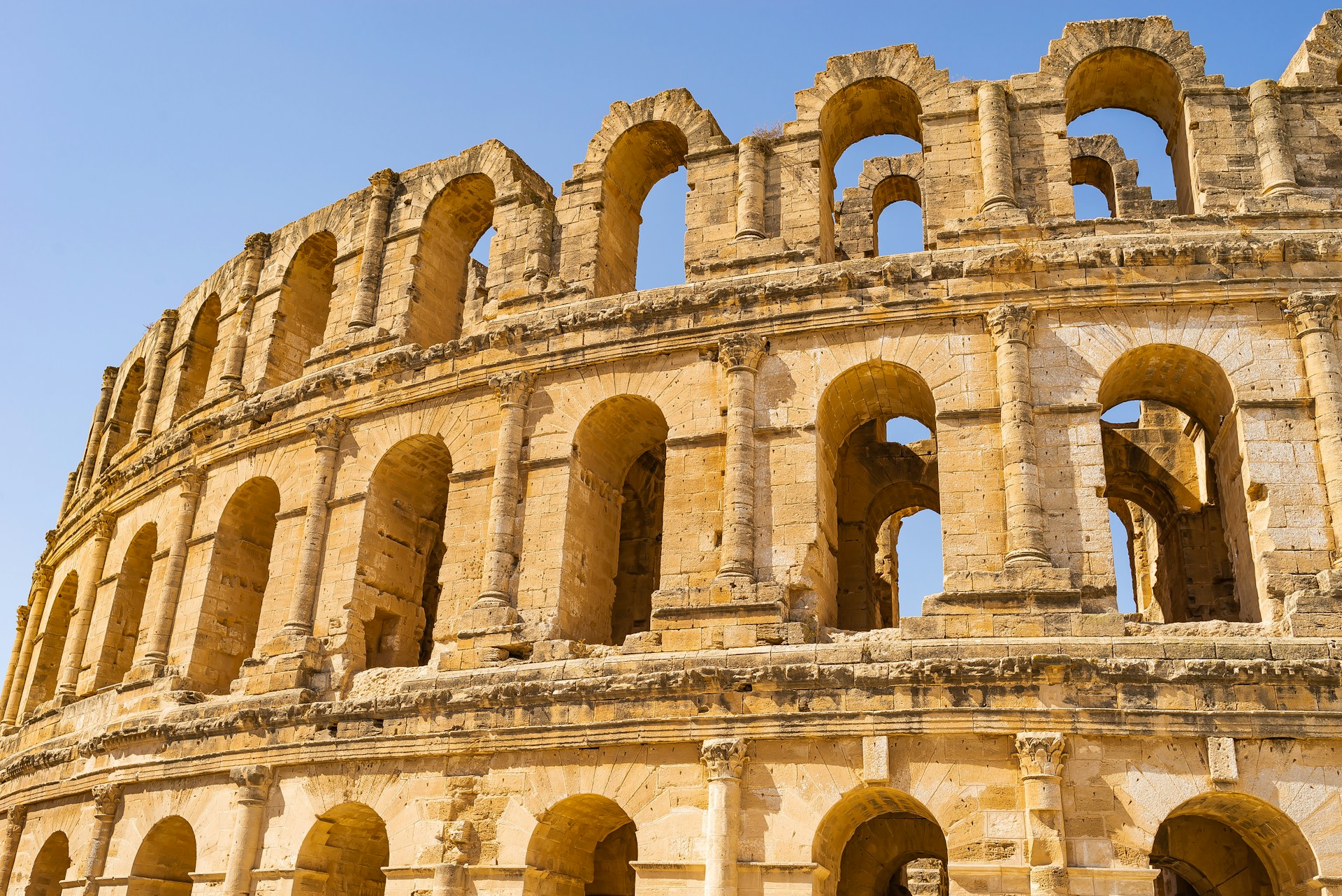
Few ruins surprised us as much as El Djem, a Roman amphitheater rivaling the Colosseum in scale, sitting almost incongruously in the middle of a small inland town far from any coastline. Climbing to the upper tiers gave us a full view of its oval structure, remarkably intact after nearly two thousand years, with none of the crowds that would surround an equivalent site in Rome itself.
Tozeur and the Sahara's Edge
From El Djem, we drove south toward Tozeur, where the landscape shifted dramatically from Roman ruins to palm-filled desert oases. Tozeur's old town, built from distinctive yellow-brick patterns unique to the region, led us into the surrounding palmeries - dense groves fed by natural springs that have sustained desert life here for centuries.
Chebika and the Mountain Oases
A short drive from Tozeur, the mountain oasis of Chebika offered some of the most striking contrast of the whole trip - a waterfall and lush palm grove tucked into an otherwise barren, rocky canyon. The nearby oasis of Tamerza, partially abandoned after flooding decades ago, added an eerie, cinematic quality to our photographs, with old stone ruins half-swallowed by the surrounding landscape.
Douz and the True Sahara
We ended the desert leg of our trip in Douz, often called the gateway to the Sahara, joining a camel trek out into the dunes at sunset. Watching the light shift across the sand as temperatures dropped fast after dark gave us some of the most vivid desert photography of the entire journey, and a night camping under an unusually clear sky made the long drive south feel entirely worth it.
Tunisia's Underrated Advantage
What struck us most about Tunisia was how much history and landscape diversity exists within such a compact country - Roman ruins, Mediterranean villages, and Sahara oases all reachable within a matter of days, without the crowds that similar sites draw in neighboring countries. It's the kind of destination that rewards travelers willing to look past the more obvious North African itineraries.
Planning Your Own Trip
Spring and autumn offer the most comfortable temperatures for combining coastal and desert travel without extreme heat in either region. Renting a car or hiring a driver gives far more flexibility for reaching sites like El Djem and Chebika, which sit outside the reach of most organized tour circuits.