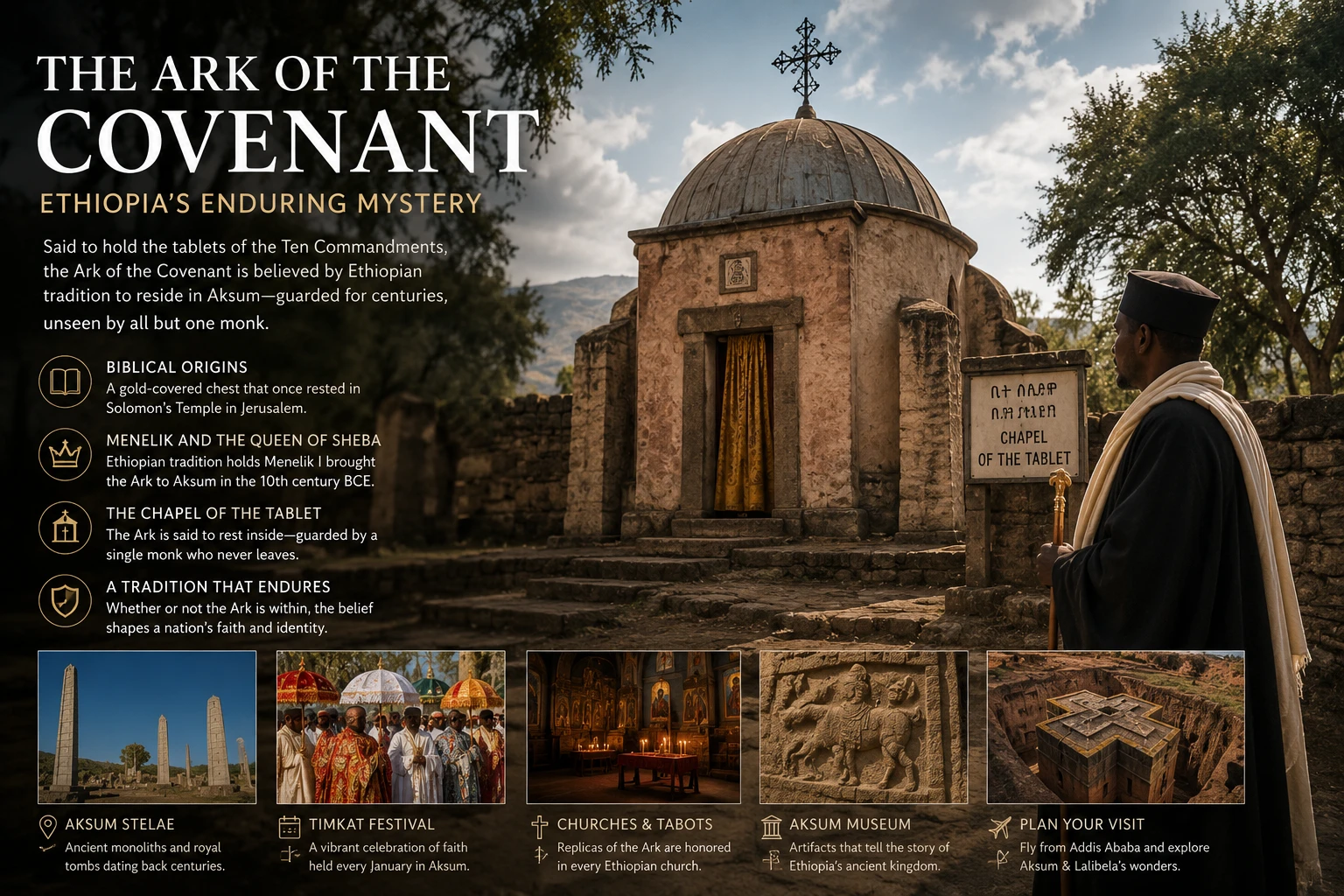
We stood outside the Chapel of the Tablet in Aksum, a small, unremarkable-looking building guarded by a single monk who, according to tradition, has never left its grounds, and tried to reconcile the modest setting with the enormity of what's said to rest inside. Few objects in religious history carry as much mystery as the Ark of the Covenant, and Ethiopia's claim to hold it remains one of the most enduring, unresolved stories we've encountered anywhere on this continent.
What the Bible Says About the Ark
The Ark of the Covenant is described in the Old Testament as a gold-covered wooden chest containing the tablets of the Ten Commandments, carried by the Israelites and eventually housed in Solomon's Temple in Jerusalem. Its disappearance from the biblical record after the Babylonian destruction of the Temple in the sixth century BCE has left a gap that traditions across multiple cultures have tried to fill in the centuries since.
No verified physical evidence of the Ark's current location exists anywhere in the world, a fact worth stating clearly before diving into the traditions that follow.
The Ethiopian Tradition: Menelik and the Queen of Sheba
Ethiopian tradition, recorded most extensively in a fourteenth-century text called the Kebra Nagast, holds that Menelik I, the son of King Solomon and the Queen of Sheba, brought the Ark from Jerusalem to Aksum. According to this account, Menelik took the Ark either with his mother's knowledge or without it, depending on the version told, and it has remained in Ethiopia ever since, moving between several locations before settling permanently in Aksum.
This tradition is deeply woven into Ethiopian national and religious identity, extending well beyond the church itself into local culture, art, and even the design of Ethiopian Orthodox churches, which each contain a replica ark called a tabot at their center.
The Chapel of the Tablet
The Ark is said to currently reside in the Chapel of the Tablet, a structure adjacent to the Church of Our Lady Mary of Zion in Aksum, guarded continuously by a single monk chosen to serve as its sole guardian for life. No outsider, including scholars, journalists, and even most Ethiopian clergy, has been permitted to view the object directly in living memory, which means its existence rests entirely on unbroken tradition rather than independent verification.
We photographed the chapel's exterior respectfully, aware that this is one of the very few religious sites in Ethiopia where getting closer simply isn't an option, regardless of who's asking.
Why the Story Persists
Part of what makes Ethiopia's claim distinct from other Ark theories circulating elsewhere in the world is the depth of institutional and cultural commitment behind it - an entire liturgical tradition built around the tabot concept, a dedicated priestly guardianship lineage, and a national narrative that predates most competing theories by centuries. Whether or not the actual biblical Ark is inside, the tradition itself has shaped Ethiopian Orthodox identity in ways that are undeniably real and observable.
Other Theories Worth Knowing
Competing theories place the Ark's possible fate in Jerusalem, hidden beneath the Temple Mount, or suggest it was destroyed or lost entirely during the Babylonian conquest. None of these theories, including Ethiopia's, have produced verifiable physical evidence, and we think it's worth being transparent about that uncertainty rather than presenting any single tradition as settled history.
Visiting Aksum Today
Aksum remains an active pilgrimage site, particularly during the annual Timkat festival, when replica tabots from churches across Ethiopia are processed publicly in one of the country's most significant religious celebrations. Visitors can tour the church grounds, the nearby stelae field, and Aksum's archaeological museum, though the Chapel of the Tablet itself remains, and will likely always remain, off-limits to public viewing.
Planning Your Own Trip
Aksum is reachable by a short domestic flight from Addis Ababa, and combining it with a visit to Lalibela's rock-hewn churches makes for a natural extension of any Ethiopian religious heritage itinerary. Timing a visit around Timkat, typically in mid-January, offers a far more vivid sense of how central this tradition remains to Ethiopian religious life today, though it also means significantly larger crowds throughout Aksum.