Among the New Testament's many miracle accounts, few carry the same quiet, human-scale detail as the story of a young boy who offers up his own small lunch, setting in motion one of Jesus's most well-known miracles. It's a story built around an unnamed child's simple willingness to give, rather than around dramatic confrontation or grand declaration.
The Setting: A Hungry Crowd
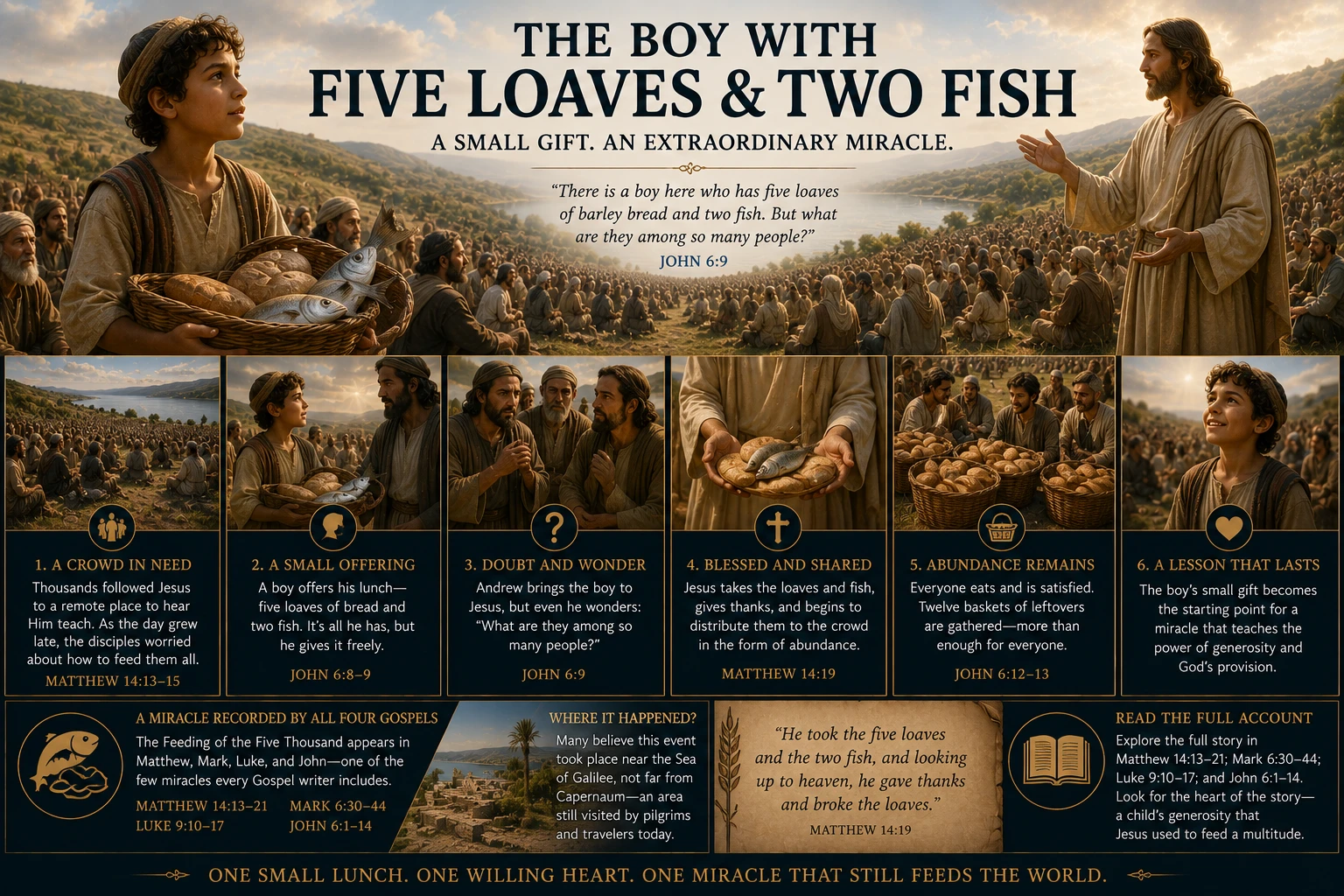
The account appears across multiple Gospel accounts, describing a large crowd, numbering in the thousands, that had gathered to hear Jesus teach and had followed him to a remote location far from any obvious source of food. As the day wore on, Jesus's disciples grew concerned about how to feed such a large gathering, given the practical impossibility of finding enough food for that many people in such a setting.
It's within this moment of logistical crisis that the boy's small offering enters the narrative, noted specifically in the Gospel of John as five loaves of bread and two fish.
A Small Gift, Freely Given
What makes this detail so notable is the contrast between the boy's modest resources and the scale of the need in front of him - a lunch meant for one person, offered without hesitation toward a crowd of thousands. The narrative doesn't dwell on the boy's internal reasoning or reluctance; his willingness to give what little he had functions as the quiet, almost overlooked hinge point the entire miracle depends on.
Andrew, one of Jesus's disciples, is the one who brings the boy and his small provisions to Jesus's attention, though even Andrew's own comment in the text reflects doubt about how such a small amount could possibly matter given the size of the crowd.
The Miracle That Follows
Jesus takes the boy's five loaves and two fish, gives thanks, and begins distributing the food, which the Gospel accounts describe as multiplying sufficiently to feed the entire crowd, with baskets of leftovers gathered afterward. The specific detail of leftover baskets, rather than an exact match between supply and need, reinforces the narrative's emphasis on abundance rather than mere sufficiency.
This event, often referred to as the Feeding of the Five Thousand, appears in all four Gospels, making it one of the few miracles recorded with that level of consistency across the entire New Testament narrative.
The Boy's Role in a Larger Story
While the boy himself remains unnamed and appears only briefly within the broader account, his small act of generosity functions as the narrative's starting point, the initial gift that Jesus then multiplies far beyond its original scale. The story's structure suggests that the miracle depended not on the size of what was offered, but on the willingness to offer it at all.
A Story About Ordinary Generosity
Much of this account's enduring appeal comes from how it centers an ordinary, unnamed child rather than a prominent religious or political figure, suggesting that meaningful contribution isn't limited to those with obvious resources or status. The boy's lunch, modest as it was, became the material starting point for an act the text presents as extraordinary.
Why This Story Continues to Resonate
The story has been retold across centuries specifically because of its emphasis on small, sincere acts of generosity as meaningful regardless of scale, a theme that continues to appear in religious teaching and broader cultural retellings alike. It offers a model of contribution that doesn't require abundance to begin with, only willingness.
Engaging With This Story Today
Readers interested in this account can find it recorded across Matthew, Mark, Luke, and John, with the Gospel of John offering the most specific detail regarding the boy and his provisions. Approaching the story with attention to its focus on small, freely given generosity, rather than solely on the miraculous multiplication itself, offers a fuller sense of why this brief episode has remained so widely remembered.