Joshua stands at one of the most consequential transition points in the Old Testament, inheriting leadership of the Israelites at the exact moment the Exodus generation's story ends and the conquest of the Promised Land begins. His narrative moves the biblical story from decades of wilderness wandering into the establishment of a settled nation, and his leadership sets the tone for everything that follows.
From Servant to Successor
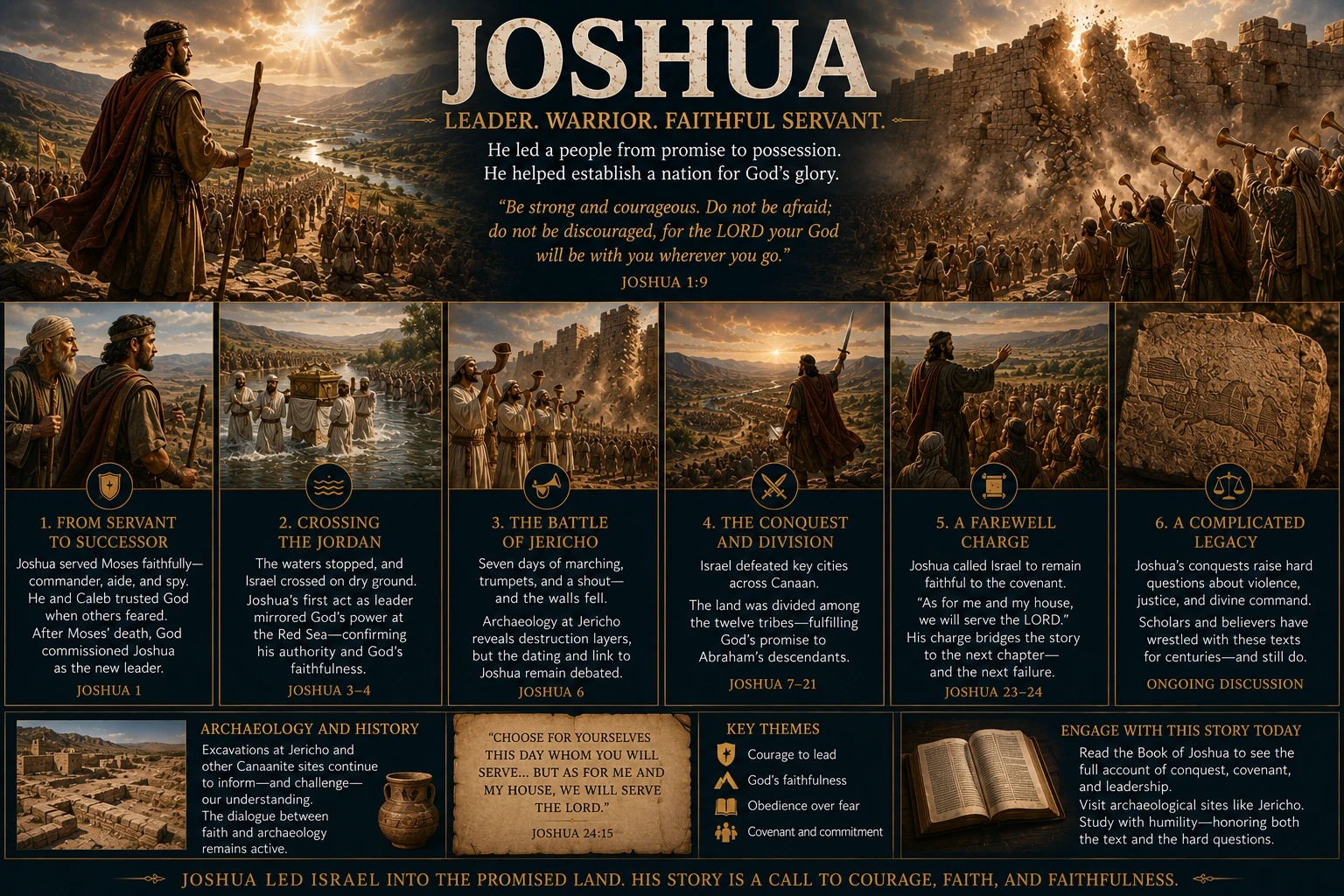
Joshua first appears in the biblical text as one of Moses's closest aides, serving as a military commander during the wilderness years and later as one of the twelve spies sent to scout the land of Canaan. His loyalty during that scouting mission, standing alongside Caleb as one of only two spies who returned with a confident, faithful report rather than one of fear, marks him early as a figure of unusual conviction within the broader Israelite community.
Following Moses's death, Joshua is formally commissioned as his successor, a transition the text frames with explicit divine reassurance, repeatedly urging Joshua to be strong and courageous as he takes on leadership of an entire nation on the edge of a monumental undertaking.
Crossing the Jordan
Joshua's first major act as leader mirrors Moses's earlier parting of the sea, with the waters of the Jordan River stopping to allow the Israelites to cross into Canaan on dry ground. This deliberate narrative echo reinforces Joshua's legitimacy as Moses's true successor, tying his leadership directly back to the same divine pattern established at the start of the Exodus story.
The Battle of Jericho
Among Joshua's most famous accounts is the fall of Jericho, where the Israelites march around the city's walls for seven days, blowing trumpets and shouting on the seventh day until the walls collapse. Archaeological work at the site of ancient Jericho has produced ongoing debate among historians and archaeologists regarding the precise dating and circumstances of the city's destruction layers, with no fully settled consensus connecting the archaeological record directly to the biblical account.
Regardless of the archaeological debate, the narrative itself frames Jericho's fall as a demonstration that the conquest of Canaan would proceed through divine intervention rather than purely conventional military strength.
The Conquest and Division of the Land
Following Jericho, Joshua leads a series of military campaigns across Canaan, described in considerable detail throughout the Book of Joshua, eventually resulting in the land being divided among the twelve tribes of Israel. This division of territory represents the fulfillment of the promise originally made to Abraham generations earlier, closing a narrative arc that spans from Genesis through to Joshua's own leadership.
A Farewell Charge to Israel
Joshua's story concludes with a farewell address to the Israelites, urging them to remain faithful to their covenant and famously declaring his own household's commitment regardless of the choices of the wider community. This final charge functions as a bridge to the Book of Judges, which follows almost immediately with a account of the nation's repeated failure to maintain that same faithfulness after Joshua's death.
Joshua's Complicated Legacy
Joshua's narrative, particularly the conquest campaigns, has generated significant theological and ethical discussion across centuries of interpretation, with readers and scholars grappling with the violence described in the text alongside its framing as divinely sanctioned. This tension remains an active area of theological and historical discussion rather than a settled question, and serious engagement with Joshua's story requires sitting with that difficulty rather than avoiding it.
Engaging With This Story Today
Readers interested in Joshua's full account can find his narrative in the Old Testament book bearing his name, situated directly between Deuteronomy and Judges within the broader biblical timeline. Approaching his story alongside archaeological findings from sites like Jericho offers a fuller, more textured understanding of how the biblical narrative and historical record intersect and, at points, remain unresolved.